The Benefits of Apologizing to Children: As adults in the household, we often feel the need to appear infallible in front of our children. Driven by work-related stress, fatigue, or haste, we might raise our voices, fail to keep a promise, or pass judgment before hearing the full story. In many homes, there is a common belief that "if adults apologize, children will become unruly" or "it will diminish our authority/respect." In reality, however, when parents openly and gracefully acknowledge their mistakes, it does not weaken them; rather, it imparts one of life’s most valuable and practical lessons.

Admitting a mistake is not a sign of weakness—
When children realize that their parents are human and capable of making errors, the unnecessary burden of striving for perfection is lifted. Many children become fearful, resort to lying, or begin to berate themselves when they make a mistake, simply because they perceive it as a grave offense. In a home where admitting mistakes is normalized, a child learns that making errors is an inherent part of life—what truly matters is how we go about rectifying them.
They perceive making a mistake as a grave offense.
Developing the habit of understanding and respecting emotions—
When we say "sorry" for our mistakes, we are acknowledging that our words or actions have caused hurt to someone else. This teaches children to recognize their own emotions and to respect the feelings of others. As they grow, these children develop into sensitive individuals, good friends, and thoughtful partners—people who, in their relationships, prioritize dialogue and understanding over stubbornness or ego.
Taking responsibility instead of making excuses—
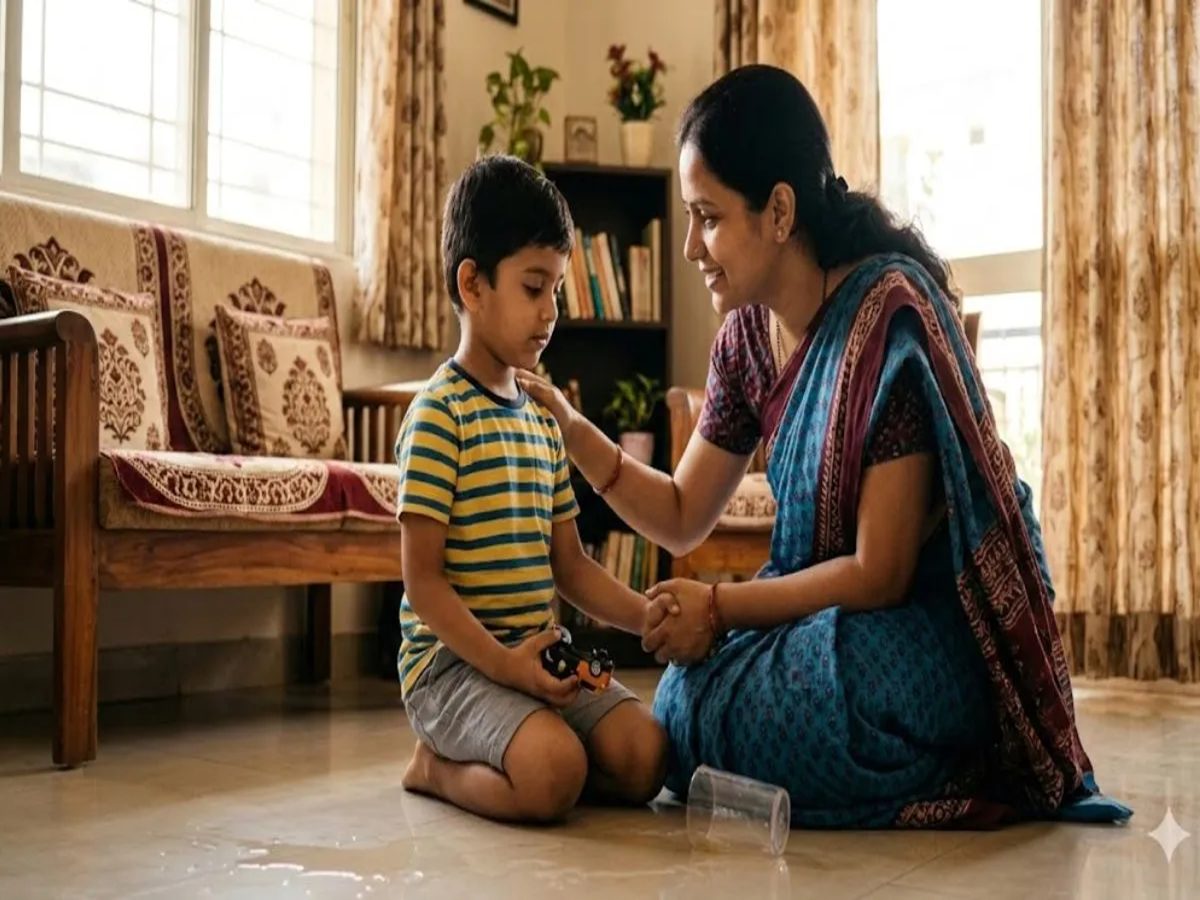
Children learn primarily from what they observe at home, rather than just from what they are explicitly taught. If parents, instead of making excuses for their own lapses, simply say, "I spoke wrongly because I was angry; I’m sorry," children learn to take responsibility for their own mistakes as well.
An article on parenting and psychology, citing Robichaud and Carina Schumann, notes:
"When parents apologize to their children, the children feel that their emotions—even after being hurt—are understood and acknowledged. When adults admit their mistakes, children and adolescents become more comfortable apologizing for their own errors later on, as they learn from this behavior modeled by the adults."
Consequently, instead of shifting blame onto others or concocting excuses, children learn how to handle such situations constructively.
Strengthening the bond of trust between parent and child—
A common misconception is that admitting a mistake diminishes a child's respect for adults. In reality, the opposite is true. When parents admit their mistakes without any ego, the child’s trust in them deepens. The child comes to believe that their parents are fair and honest, which allows them to openly share their problems or mistakes even as they grow older.
Why is this habit essential for parenting?
In today’s fast-paced life, the communication gap between parents and children is widening rapidly. In such a context, the habit of admitting mistakes acts as an emotional bridge. It transforms parenting from a process of "issuing commands" into one of "journeying and learning together." Furthermore, it keeps the home environment light and healthy—ensuring that adults are not burdened by hidden guilt, and children are not left harboring fear or resentment.
What is an easy way to adopt this practice?
There is no need to provide a long, elaborate explanation every single time. Simply saying something like, “I was a bit upset today, which is why I snapped at you—that wasn’t right,” or “I couldn’t keep the promise I made; I’ll be more mindful next time,” is enough.
Such honesty brings a renewed warmth to family relationships.
Ultimately, in a home where parents acknowledge their own mistakes, children learn more than just how to say “sorry”; they learn to navigate life with truthfulness, humility, and self-confidence. Being an authentic and understanding parent is far more important than being a “perfect” one.
PC Social Media