

Ram Mandir Dhwajarohan On Vivah Panchami: The sacred festival of Vivah Panchami will be celebrated across the country on Tuesday, November 25th. On this auspicious day, a saffron flag will be hoisted on the top of the Shri Ram Temple in Ayodhya. In Hindu traditions, the temple flag is considered a symbol of the deity's presence, protection, and purity. When the Dharma flag is hoisted on a temple, it is not merely an ornament but a sign of the arrival of cosmic energy and divine power. This flag hoisted on the top of the Shri Ram Temple will symbolize the historic journey that has been traversed through generations of faith, struggle, waiting, and dedication.

Lord Surya, 'Om', and the Kovidar Tree are inscribed on the saffron flag.
Lord Surya, 'Om', and the Kovidar Tree are engraved on the saffron flag, special for the Shri Ram Temple. These are considered symbols of the Suryavansh (the Sun dynasty). 'Om' is considered the ultimate mantra, the most powerful and sacred mantra in the universe. Scientists have also acknowledged that the sound emanating from the Sun is similar to 'Om'. When placed alongside the Sun, it signifies the union of creation, energy, and divinity. The Sun symbolizes life and light, and Om symbolizes the soul and the Supreme Being. Together, they convey life, power, and spiritual energy.
The Kovidar Tree's Connection to the Ramayana and Ayodhya
According to the Harivansh Purana, the Kovidar tree was once part of the royal flag of Ayodhya. For this reason, it was also featured on the flag of the magnificent Ram Temple. It is also mentioned in the Valmiki Ramayana.
In an episode in the Ramayana, when Bharata arrived in Chitrakoot to bring Shri Ram back to Ayodhya, his chariot bore a flag depicting the Kovidar tree. Lakshmana recognized this flag from a distance, recognizing it as belonging to the army of Ayodhya.
On this basis, the Kovidar tree was once considered the "royal tree" of Ayodhya, just as the banyan is the national tree of India today. Therefore, the Kovidar tree has been honorably included again in the flag symbolizing Ram Rajya.
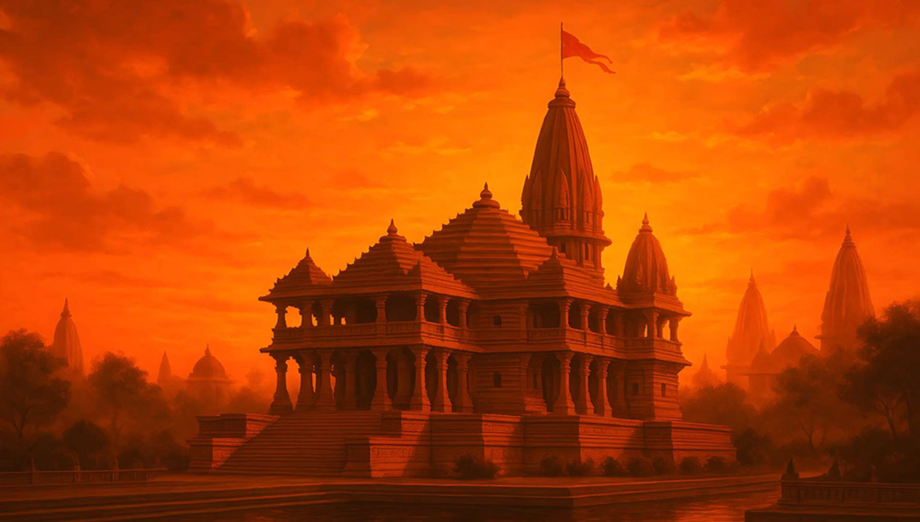
Flag Hoisting in Abhijit Muhurta
The auspicious time for hoisting the flag on the top of the Shri Ram Temple is fixed during the Abhijit Muhurta. Abhijit Muhurta is considered the most auspicious of all auspicious times. It is the middle part of the eighth Muhurta of the day. It is believed that any work started during this Muhurta is sure to be successful and bring victory to the individual. Both the groundbreaking ceremony and Pran-Pratishtha of the Shri Ram Temple took place during the Abhijit Muhurta. Hoisting the flag during this Muhurta signifies that God's blessings remain upon all and that the ideals of Ramrajya are established.
PC Social Media