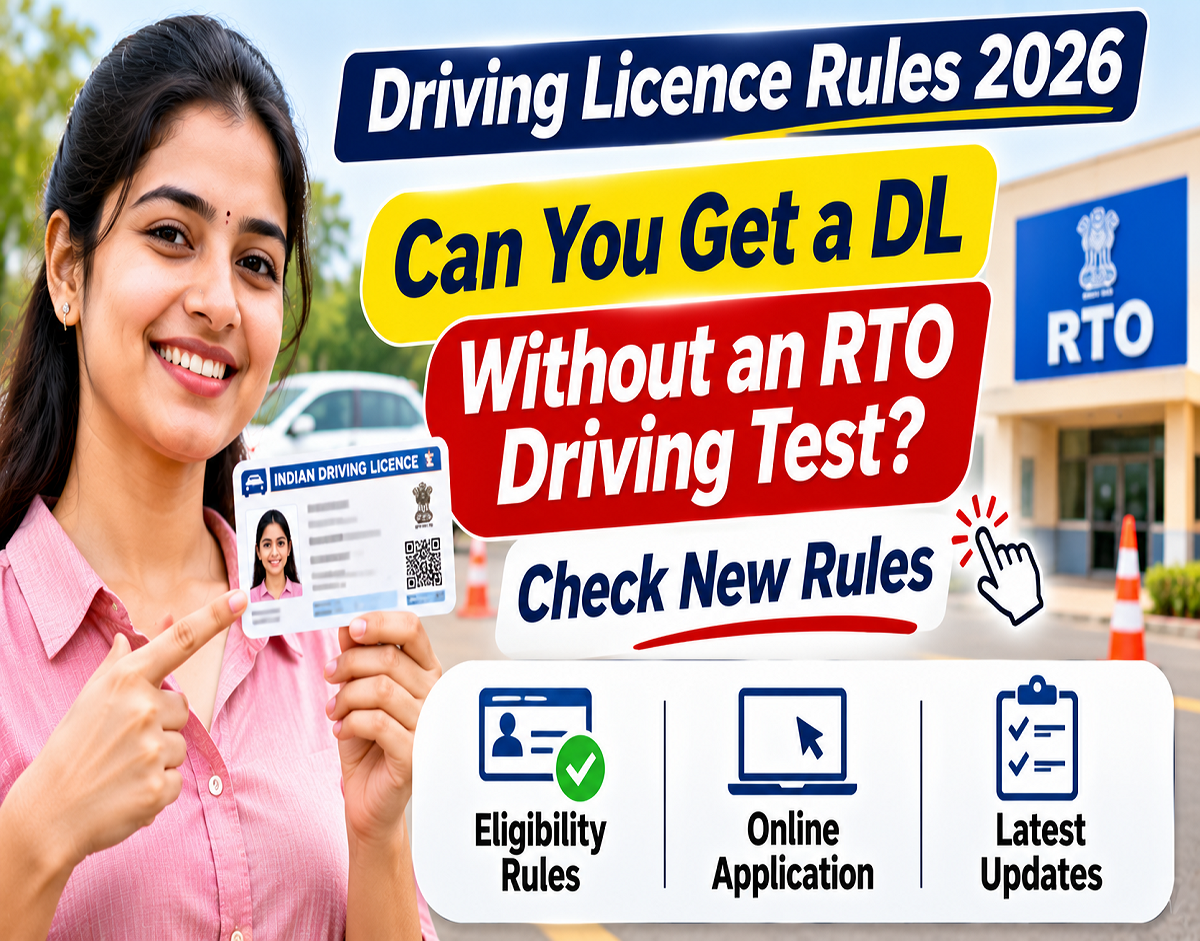
Driving Licence Rules 2026: Applying for a driving licence in India has become more convenient with online services and provisions allowing eligible applicants to complete driving training and testing through accredited centres. These arrangements can reduce the need to visit a Regional Transport Office (RTO) for certain procedures.
Under the Ministry of Road Transport and Highways' framework, applicants who successfully complete the prescribed training and driving test at an authorised Accredited Driver Training Centre (ADTC) may qualify for exemption from the driving skill test normally conducted by the licensing authority.
However, this does not mean that anyone can obtain a driving licence without passing a driving test. Applicants must meet the applicable training, assessment, documentation and eligibility requirements.
Here is what drivers should know about the RTO test exemption, recognised driving schools, online applications and medical fitness rules in 2026.
Driving Licence Rules 2026: What Has Changed?
The government has introduced measures to simplify driving licence services while maintaining road safety standards.
One important provision allows eligible applicants to complete prescribed training and testing at accredited driving training centres.
After successfully passing the required assessment, an applicant may receive a certificate that can be used for the driving test exemption available under the relevant rules.
This can reduce the need to take a separate driving skill test at the RTO.
However, the licensing authority remains responsible for issuing the driving licence.
The provision is part of an earlier regulatory framework and should not be described as a completely new nationwide waiver introduced in October 2026.
Can You Get a Driving Licence Without Visiting the RTO?
In certain cases, applicants may be able to complete much of the driving licence process online and avoid a separate RTO driving skill test.
However, the availability of a fully contactless process depends on the state, the type of application and the services supported by the licensing authority.
Applicants who qualify for the accredited training centre exemption may not need to appear for the regular driving skill test at the RTO.
Other requirements, including identity verification, medical fitness where applicable and payment of prescribed fees, must still be completed.
Some applicants may also be required to visit an authorised facility for verification or other formalities.
Therefore, it is important to distinguish between exemption from the RTO driving test and exemption from the entire licensing process.
Who Can Get an RTO Driving Test Exemption?
The exemption is intended for applicants who successfully complete the prescribed course and driving test at an eligible accredited driving training centre.
The centre must hold the appropriate accreditation under the applicable government framework.
Applicants must complete the required training and satisfy the centre's assessment standards.
A certificate issued by an ordinary private driving school does not automatically qualify a person for exemption.
Only certificates recognised under the applicable licensing rules can be used for this purpose.
Applicants should verify the accreditation status of a training centre before paying for a course.
Are All Private Driving Schools Eligible?
No. This is one of the most important points for applicants.
India has many private driving schools offering lessons for two-wheelers, cars and commercial vehicles.
However, not every driving school is authorised to provide training and testing certificates that qualify for an RTO driving test exemption.
An Accredited Driver Training Centre must meet prescribed infrastructure, equipment, staffing and training requirements.
Applicants should ask whether the centre is officially accredited for the relevant category of vehicle.
They should also confirm whether its certificate is accepted for the intended driving licence application.
What Facilities Must Accredited Driving Training Centres Have?
The regulatory framework prescribes infrastructure and training standards for accredited centres.
Depending on the applicable category and accreditation requirements, facilities may include suitable training grounds, qualified instructors, classrooms and driving simulators.
The framework also includes specified land requirements, with different standards applying to light and heavy motor vehicle training facilities.
Training centres may be required to maintain appropriate records and assessment systems.
These requirements are intended to ensure that candidates receive practical driving instruction and understand traffic rules before obtaining a licence.
However, individual accreditation conditions should be checked against the current official rules rather than assuming that every private driving school follows the same requirements.
How to Apply for a Driving Licence Online in 2026
Applicants can access driving licence services through the government's Parivahan platform.
The general application process is as follows:
- Visit the official Parivahan website.
- Open the Driving Licence Related Services section.
- Select the relevant state.
- Choose the required service, such as learner's licence or new driving licence.
- Enter the requested personal information.
- Upload documents where the online facility is available.
- Complete the required declarations and medical forms.
- Pay the applicable government fees.
- Book a test or appointment if required.
- Follow the instructions issued by the state licensing authority.
Applicants who have completed an eligible accredited training programme should follow the specific process for submitting their recognised training certificate.
The exact steps can vary between states.
Is a Learner's Licence Still Required?
The accredited training centre provision should not be confused with a blanket exemption from learner's licence requirements.
Applicants must comply with the eligibility conditions and licensing procedures applicable to their vehicle category.
For a regular driving licence, the learner's licence framework and prescribed waiting periods generally remain relevant unless a specific legal provision applies.
Applicants should check the instructions displayed on the Sarathi portal for their state.
Driving without a valid licence or learner's licence authorisation remains subject to applicable traffic laws.
Medical Certificate Rules for Driving Licence Applicants
Medical fitness is another important part of the driving licence process.
Under the applicable licensing framework, applicants aged 40 years or above are generally required to submit a medical certificate in Form 1A.
Form 1A is also relevant to specified transport vehicle licence applications.
The certificate must be issued by an authorised registered medical practitioner in accordance with the rules.
Applicants below the prescribed age threshold may be required to complete the relevant self-declaration of physical fitness, depending on the licence category.
Medical requirements should be verified through the official application portal before submission.
What Documents Are Needed for a Driving Licence?
The documents required may vary depending on the applicant's state, age and licence category.
Common requirements include proof of identity, proof of age, address information and an existing learner's licence where applicable.
Applicants may also need to provide a photograph, signature and medical fitness documentation.
Where an accredited training centre exemption is claimed, the recognised training and assessment certificate may be required.
The application portal will display the documents applicable to the selected service.
Will the New Process Save Time and Money?
The accredited training centre route may help some applicants avoid waiting for a separate RTO driving test appointment.
Online applications can also reduce unnecessary visits for document submission and fee payment.
However, applicants should not assume that the accredited training route will always be cheaper.
Private training centres may charge course fees in addition to applicable government licensing charges.
The total cost depends on the training programme, vehicle category and services provided.
Applicants should compare costs and confirm the centre's accreditation before enrolling.
Important Things to Check Before Applying
Applicants should ensure that they are using official government websites and recognised training facilities.
They should avoid agents who promise a driving licence without any training, assessment or verification.
A genuine driving licence must be issued through the authorised licensing system.
It is also important to confirm whether the selected state supports the relevant online and contactless services.
Applicants can track their application through the official Parivahan platform and should retain their application number and payment acknowledgement.
Final Words
India's driving licence framework allows eligible applicants who successfully complete training and testing at accredited driving training centres to obtain an exemption from the separate RTO driving skill test.
However, this is not a general permission to obtain a driving licence without demonstrating driving competence.
Applicants must still satisfy the applicable age, documentation, training, medical and licensing requirements.
Before applying, candidates should verify the accreditation of their driving school and check the latest instructions on the official Parivahan portal.