FASHION
Kangana Ranaut looks stunning in a white Jamdani saree; find out what makes this Bengali saree so special...

While campaigning in Bengal, actress and Mandi MP Kangana Ranaut was spotted wearing a white Jamdani saree during a roadshow. Kangana looked stunning in this attire, and her saree drew considerable attention from everyone around.
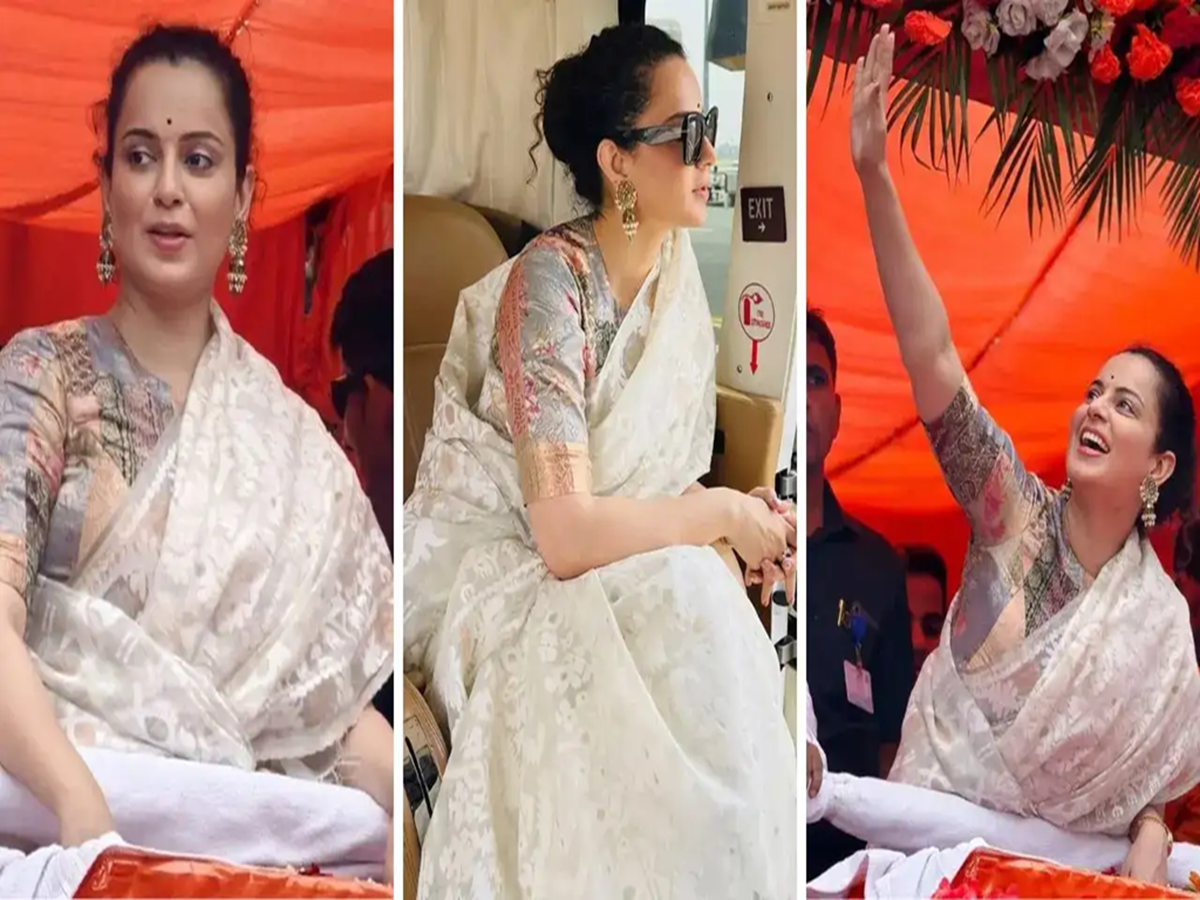
The Jamdani saree shares a deep-rooted connection with the culture of Bengal. Therefore, Kangana’s choice to wear this saree during her election campaign was no mere coincidence. Let us explore the bond between the Jamdani saree and Bengal, and understand why this particular garment is considered so special.
**Why is Jamdani Special?**
The Jamdani saree stands as a prime example of one of the most advanced and intricate arts in the world of hand-weaving. Renowned for its sheer texture and velvety designs, Jamdani is a source of immense pride for Bengal's cultural identity. In 2013, it was designated as Intangible Cultural Heritage by UNESCO, a recognition that elevates the significance of this art form even further.
**The Origins and History of Jamdani**
Historically, the epicenter of this art form has been Dhaka—the capital of Bangladesh—and its surrounding regions. Consequently, this saree is inextricably linked to the cultural fabric of Bengal. During the Mughal era, the art received royal patronage, allowing its intricacy and quality to reach their absolute zenith.
Initially, Jamdani motifs were inspired by nature, yet their structural composition remained geometric. An intriguing reason behind this lies in the fact that the weavers did not rely on machinery; instead, they utilized thread counts to create their designs, resulting in shapes that were angular and precise.
**What are the Distinctive Features of Jamdani?**
What sets Jamdani apart from other sarees is its unique "discontinuous weft" technique.
**Hand-Weaving:** This process involves no use of printing or embroidery machines to create the designs. Instead, the weaver meticulously weaves motifs by interlacing additional threads amidst the main warp threads on the loom.
**Lightweight and Airy:** Crafted from fine muslin or cotton fabric, the Jamdani saree is exceptionally lightweight and offers unparalleled comfort to the wearer. Traditional Motifs—*Chameli*, *Panna Hazar*, and *Phulwar* are some of its renowned designs.
Community Art—Jamdani represents not merely the labor of a single weaver, but the unity of an entire community—comprising dyers, spinners, and loom dressers.
How long does it take to create one?
It takes weavers anywhere from several months to several years to create a single Jamdani saree. The time required for weaving depends entirely on the complexity of the design. A skilled artisan can typically weave only between a quarter of an inch and one inch of fabric per day. At this rate, a simple Jamdani saree takes at least six months to complete.
If the design is exceptionally intricate and dense, a pair of weavers working ten hours a day may take up to three years to finish a single saree.

Jamdani: A Legacy Spanning Centuries
In an era where machines can churn out hundreds of sarees in mere minutes, Jamdani remains a priceless treasure today, cherished for its exquisite intricacy. This saree is not merely a piece of fabric; it is the living legacy of the weaving families who have kept this art form alive, passing it down from generation to generation.
PC Social Media