Business
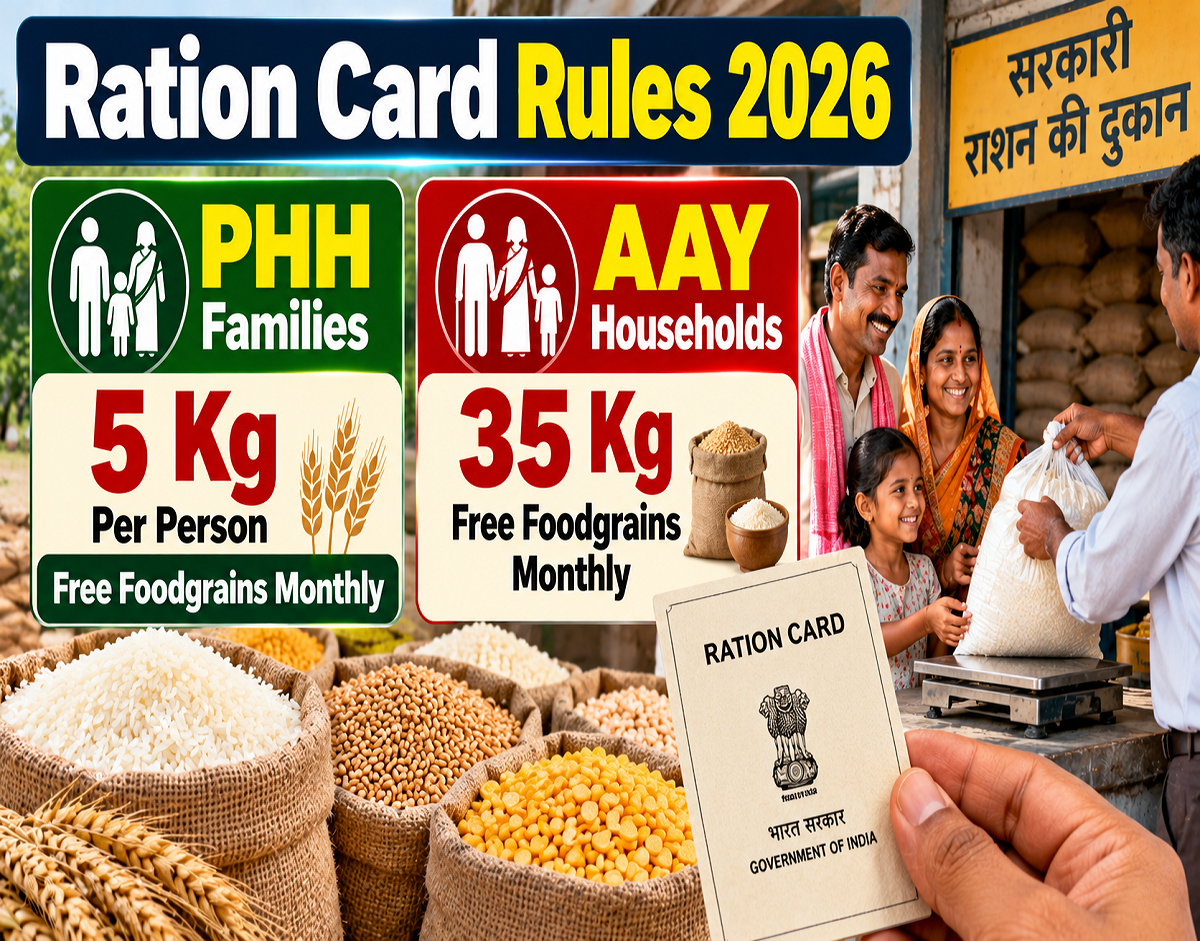
Ration Card Rules 2026: PHH Families Get 5 Kg Per Person, AAY Households Receive 35 Kg Free Foodgrains Monthly
Ration Card Update 2026: Millions of eligible families across India receive subsidised or free foodgrains through the Public Distribution System (PDS). However, the amount of ration a household can collect every month depends on its eligibility category and, in some cases, the number of family members registered on the ration card.
Under the National Food Security Act (NFSA), 2013, eligible beneficiaries are covered primarily under two categories: Priority Households (PHH) and Antyodaya Anna Yojana (AAY).
The central government provides 5 kilograms of foodgrains per eligible person per month under PHH, while an AAY household is entitled to 35 kilograms per month, irrespective of the number of members in that household.
Eligible NFSA beneficiaries receive their prescribed foodgrain entitlement free of cost under the Pradhan Mantri Garib Kalyan Anna Yojana (PMGKAY) arrangement. The government approved continuation of free foodgrain distribution for five years from January 1, 2024.
Understanding these rules can help families verify their monthly allocation and identify possible discrepancies at fair price shops.
PHH vs AAY Ration Card: Key Differences
| Particulars | PHH Ration Card | AAY Ration Card |
|---|---|---|
| Full name | Priority Household | Antyodaya Anna Yojana |
| Target beneficiaries | Eligible priority households | Poorest and most vulnerable eligible households |
| Monthly foodgrain entitlement | 5 kg per eligible person | 35 kg per household |
| Calculation method | Based on registered eligible members | Fixed household allocation |
| Does family size affect quantity? | Yes | No |
| Price under current central free-foodgrain arrangement | Free | Free |
| Governing framework | NFSA, 2013 | NFSA, 2013 |
These are central NFSA foodgrain entitlements. Additional commodities or state-specific benefits may vary.
How Much Ration Does a PHH Cardholder Receive?
The Priority Household category covers families identified as eligible under the criteria adopted by their respective state or Union Territory governments.
For PHH households, the foodgrain entitlement is calculated individually.
Each eligible person included in the ration card is entitled to 5 kg of foodgrains per month.
For example, a family with four eligible members can receive 20 kg of foodgrains monthly.
A family with six eligible members can receive 30 kg.
PHH Ration Calculator
Calculate your monthly PHH foodgrain entitlement
Select the number of eligible family members listed on the ration card.
Eligible family members
4
Total monthly foodgrains
20 kg
4 × 5 kg per eligible person
This calculation applies to eligible PHH members under the central NFSA entitlement.
The following table illustrates common household sizes.
| Eligible Members | Monthly PHH Foodgrains |
|---|---|
| 1 | 5 kg |
| 2 | 10 kg |
| 3 | 15 kg |
| 4 | 20 kg |
| 5 | 25 kg |
| 6 | 30 kg |
| 7 | 35 kg |
| 8 | 40 kg |
Importantly, the entitlement depends on the number of eligible individuals recorded in the official ration card database, not simply the number of people currently living in the house.
If a new family member has not been added to the ration card, their entitlement may not be included until the relevant update is approved.
AAY Ration Card: Who Gets 35 Kg Every Month?
Antyodaya Anna Yojana is intended to provide food security to the poorest eligible households.
Unlike PHH, the AAY foodgrain allocation is not calculated separately for each member.
Instead, an eligible AAY household receives a fixed entitlement of 35 kg of foodgrains every month.
This means that a family with three members and a family with six members can each receive 35 kg, provided they are classified as AAY households.
AAY Entitlement by Family Size
| Family Members | Monthly Foodgrain Allocation |
|---|---|
| 2 | 35 kg |
| 3 | 35 kg |
| 4 | 35 kg |
| 5 | 35 kg |
| 6 | 35 kg |
| 7 | 35 kg |
The quantity remains fixed at the household level under the central AAY entitlement.
State governments identify eligible AAY households according to the applicable criteria and administrative procedures.
Are PHH and AAY Foodgrains Free in 2026?
Under the central government's free-foodgrain distribution arrangement, eligible NFSA beneficiaries receive their prescribed monthly allocation without paying for the covered foodgrains.
The government approved free distribution under PMGKAY for five years beginning January 1, 2024.
Accordingly, the arrangement covers 2026, subject to applicable government rules and eligibility.
However, free distribution of NFSA foodgrains should not be confused with every item that may be available through a ration shop.
Certain state governments may provide additional commodities such as pulses, sugar, salt or edible oil under separate schemes.
The availability, price and eligibility conditions for these items can differ from state to state.
Beneficiaries should therefore check their state's official food and civil supplies information for additional benefits.
How Can You Check Your Ration Card Category?
A household's monthly entitlement depends on whether it is classified as PHH or AAY.
Beneficiaries can check their ration card category through the relevant state food and civil supplies portal or authorised ration card records.
The National Food Security Portal also provides links to state and Union Territory food departments.
Official portal: National Food Security Portal
After opening the appropriate state portal, beneficiaries can look for ration card details, beneficiary lists or eligibility information.
The available search methods may include ration card number, district, fair price shop or other state-specific details.
Once the record is displayed, check the category and the number of eligible members.
If any information is incorrect, contact the appropriate local food and civil supplies authority for correction.
Why Is the ePOS Receipt Important?
Most fair price shops use electronic Point of Sale (ePOS) systems to record ration distribution.
These systems help authenticate eligible beneficiaries and maintain electronic transaction records.
After collecting foodgrains, beneficiaries should check the transaction details and retain the receipt where one is issued.
The receipt can help establish how much foodgrain was recorded as distributed.
For example, if a PHH family with five eligible members is entitled to 25 kg, the beneficiary should check that the recorded transaction matches the quantity actually received.
If the ePOS system shows a higher quantity than what was handed over, the discrepancy should be reported.
Beneficiaries should also check the weighing process and avoid accepting unexplained deductions.
What Should You Do if a Ration Dealer Gives Less Foodgrain?
If a beneficiary receives less than the prescribed entitlement, they should first verify their ration card category and registered member count.
If the allocation is correct but the delivered quantity is lower, they can raise the issue with the fair price shop dealer.
Where the discrepancy remains unresolved, a complaint may be submitted to the local Food and Civil Supplies Department or the designated state grievance authority.
Useful supporting information may include the ration card number, fair price shop details, distribution date, ePOS transaction record and quantity received.
Beneficiaries should use official grievance channels rather than sharing ration card or identity details with unknown individuals offering assistance.
Can You Collect Ration Outside Your Home State?
The One Nation One Ration Card (ONORC) system enables eligible NFSA beneficiaries to access their foodgrain entitlements through portability arrangements.
This is particularly helpful for migrant workers and families who temporarily live away from their registered locations.
Subject to authentication and operational rules, beneficiaries may collect eligible foodgrains from participating fair price shops outside their home state.
However, portability does not increase the household's total monthly entitlement.
For example, a PHH beneficiary entitled to 5 kg cannot claim another full 5 kg simply by visiting a second ration shop after receiving the monthly allocation.
Distribution records are used to account for the quantity already collected.
Important Points for Ration Cardholders
Before visiting a ration shop, beneficiaries should confirm their card category, registered family members and monthly entitlement.
They should also check whether any ration card updates are pending, particularly after changes in family composition.
At the shop, verify the foodgrain quantity and transaction details before leaving.
If an issue arises, retain available records and contact the appropriate department.
It is also advisable to use official government websites for ration card updates and avoid suspicious messages promising additional free ration in exchange for OTPs or personal banking details.
Final Takeaway
The distinction between PHH and AAY ration cards determines how the central NFSA foodgrain entitlement is calculated.
PHH households receive 5 kg per eligible member each month, while AAY households receive a fixed 35 kg per month regardless of family size.
These prescribed foodgrains are provided free to eligible beneficiaries under the current central government arrangement.
Ration cardholders should verify their category, check the quantity received and report any mismatch through official food department channels.
Disclaimer: The quantities described are central NFSA entitlements. State-specific additional benefits, eligibility conditions and distribution procedures may differ. Refer to official government notifications for the latest applicable rules.