Business
UPI Payment Rules 2026: No MDR for Consumers on Electricity, Water and Gas Bills, NPCI Clarifies
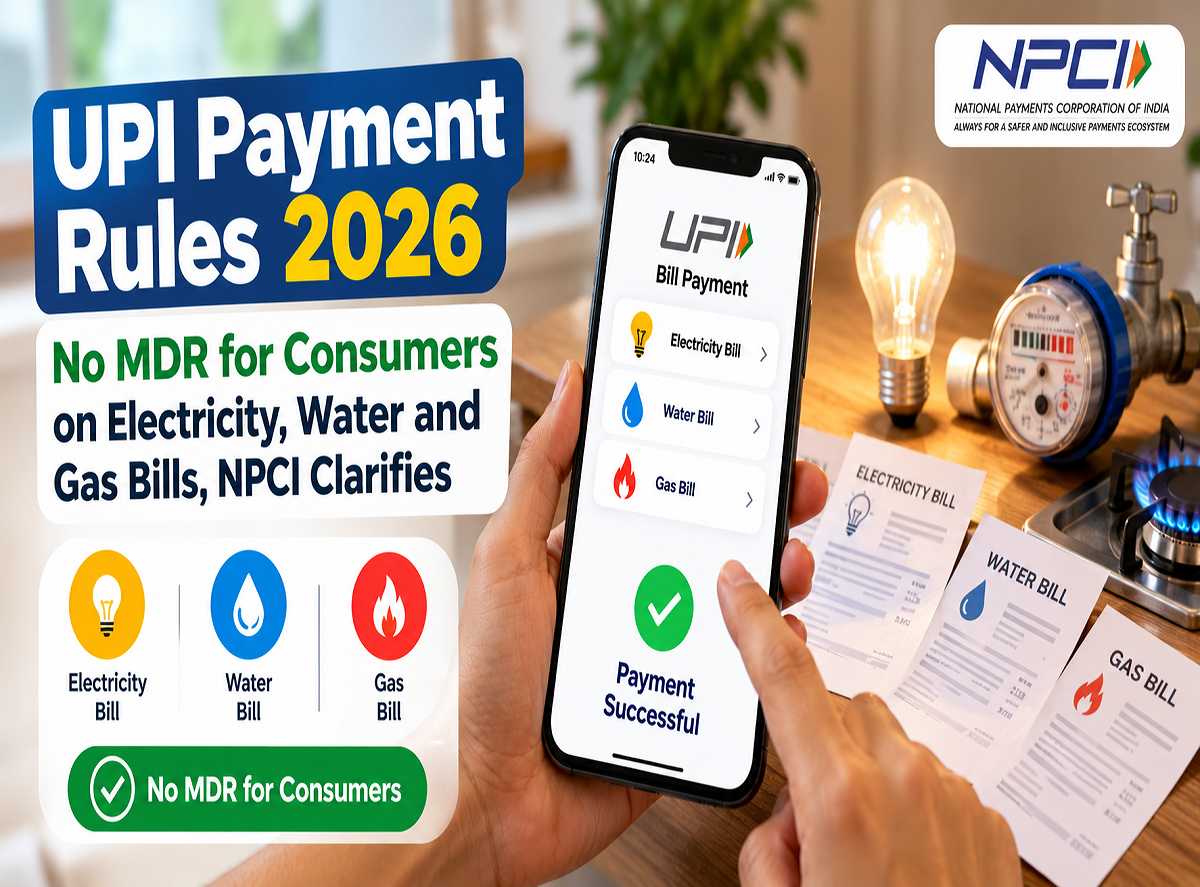
UPI Bill Payment Charges 2026: Do you pay your electricity, water or piped natural gas bills through Google Pay, PhonePe, Paytm or another UPI application? The National Payments Corporation of India (NPCI) has shared an important clarification about Merchant Discount Rate (MDR) charges on utility bill payments.
According to the official UPI awareness message, consumers do not pay MDR when making utility bill payments through UPI, including electricity distribution bills, municipal water charges and piped natural gas payments.
The clarification is important for households that regularly use digital payment platforms to settle their monthly expenses. However, users should understand the difference between MDR and other service charges that may apply under specific billing or payment arrangements.
NPCI Clarifies MDR Rules for Utility Bill Payments
NPCI has highlighted that consumers are not required to pay MDR on utility bill payments made through UPI.
The clarification covers common household expenses such as electricity distribution services, municipal water supply and piped natural gas.
These payments are frequently made through banking applications, utility company websites and third-party payment platforms.
The announcement helps explain how MDR works and why consumers should not confuse it with other charges that may appear during a transaction.
MDR is generally associated with merchant payment acceptance arrangements rather than a direct charge imposed on individual consumers.
NPCI's statement does not mean that every possible fee connected with a utility bill payment has been removed.
Which Utility Bill Payments Are Covered?
The official UPI message specifically mentions three major categories of household utility payments.
| Utility payment category | MDR payable by consumers |
|---|---|
| Electricity distribution bills | ₹0 |
| Municipal water charges | ₹0 |
| Piped natural gas bills | ₹0 |
These categories represent common recurring expenses for households across India.
For example, a customer paying an electricity bill through a supported UPI payment option does not pay MDR on that transaction.
Similarly, consumers making municipal water payments or settling piped natural gas bills through UPI are not charged MDR.
However, any separately disclosed convenience fee or service charge should be examined independently.
What Is MDR in Digital Payments?
MDR stands for Merchant Discount Rate.
It refers to a charge associated with accepting certain electronic payments.
In a typical payment arrangement, MDR may be borne by the merchant or handled among participating financial institutions and payment service providers, depending on the applicable rules.
For ordinary consumers, it is important to understand that MDR is not the same as a bank's service charge or a biller's convenience fee.
For example, if a payment platform displays a separate processing charge, that amount should not automatically be described as MDR.
The applicable rules depend on the payment instrument, service provider and transaction category.
NPCI's latest clarification specifically addresses the absence of consumer MDR on utility payments made through UPI.
Will You Pay MDR on a ₹1,000 or ₹5,000 Electricity Bill?
Consumers do not pay MDR on the utility bill payments identified in NPCI's message.
The following table illustrates the clarification using different bill amounts.
| Utility bill amount | Consumer MDR |
|---|---|
| ₹500 | ₹0 |
| ₹1,000 | ₹0 |
| ₹1,500 | ₹0 |
| ₹2,000 | ₹0 |
| ₹3,000 | ₹0 |
| ₹5,000 | ₹0 |
| ₹10,000 | ₹0 |
These are illustrative payment amounts, not separate transaction limits announced by NPCI.
The actual amount that can be paid through UPI depends on the applicable transaction limits, bank policies and payment service arrangements.
The zero-MDR clarification should also not be interpreted as a guarantee that every payment platform will offer every bill payment service without any other charge.
Is MDR Different From a Convenience Fee?
Yes. MDR and convenience fees are different concepts.
MDR is associated with payment acceptance and the relevant payment processing arrangement.
A convenience fee may be charged separately by a service provider or payment platform for a particular service, where permitted.
For example, a utility bill payment platform might display an additional service charge for a specific payment method.
Such a charge should be clearly identified and assessed according to the applicable rules.
Consumers should review the final payment amount before authorising a transaction.
If an unexpected fee appears, they can check whether another official payment channel offers a more suitable option.
How to Pay Electricity, Water and Gas Bills Through UPI
Consumers can generally make supported utility payments through their preferred UPI applications or official biller platforms.
The process typically involves the following steps:
- Open a trusted UPI application or the official website of the utility provider.
- Select the relevant bill payment category, such as electricity, water or piped gas.
- Choose the correct service provider or billing organisation.
- Enter the consumer number, account ID or other requested billing information.
- Verify the displayed bill amount and customer details.
- Review any separately disclosed service charges.
- Select the available UPI payment option.
- Authorise the transaction using your UPI PIN.
- Save the payment receipt or transaction reference for future use.
The exact steps may differ between applications and utility service providers.
Why Is This Clarification Important for Households?
Utility bills are recurring financial obligations for millions of Indian households.
Electricity and water payments are particularly common, while piped natural gas is used in areas where the relevant distribution network is available.
UPI allows consumers to complete many of these payments digitally without visiting physical payment counters.
Understanding the applicable charge structure can help users identify unexpected fees and make informed payment decisions.
The NPCI clarification also helps prevent confusion arising from broader discussions about MDR and digital payment charges.
Consumers should not assume that every mention of MDR represents an additional fee they must personally pay.
Follow These Safety Tips While Paying Utility Bills
Digital bill payments are convenient, but users should remain cautious about fraudulent messages and websites.
Scammers sometimes impersonate electricity or gas service providers and claim that a connection will be disconnected unless an immediate payment is made.
Consumers should verify such claims directly with their utility company.
Avoid installing unfamiliar applications sent through SMS or WhatsApp.
Never share your UPI PIN, OTP or banking password with someone claiming to be a billing official.
Before approving a payment, check the recipient details and amount carefully.
It is also advisable to retain the transaction receipt until the payment is reflected in the utility account.
Where Can Consumers Report UPI Payment Problems?
If a utility bill payment fails or money is deducted without confirmation, users should first check the transaction status.
They can contact the payment application, their bank or the utility service provider, depending on the nature of the problem.
For UPI-related assistance, NPCI provides an official support platform at NPCI UPI Help Portal.
If the issue involves suspected financial cyber fraud, consumers should immediately contact their bank and report the incident through the national cybercrime helpline 1930.
Complaints can also be submitted through the government's National Cyber Crime Reporting Portal.
NPCI's Message for UPI Bill Payment Users
NPCI's latest awareness message provides clarity for consumers who regularly pay household utility bills through UPI.
The organisation has confirmed that consumers do not pay MDR on electricity distribution, municipal water and piped natural gas payments made through UPI.
Nevertheless, users should continue reviewing their payment details and distinguish MDR from any other separately disclosed charges.
The key takeaway: Consumers do not pay MDR when settling the specified electricity, municipal water and piped natural gas bills through UPI. Always check the final amount before authorising a transaction.
Source Credit: National Payments Corporation of India (NPCI) — Official UPI X account (@UPI_NPCI), public awareness post dated October 29, 2026. View original NPCI announcement. Additional reference: NPCI official website.