Business
UPI Payment Failed but Money Deducted? Check Refund Rules, T+1 Deadline and How to File a Complaint
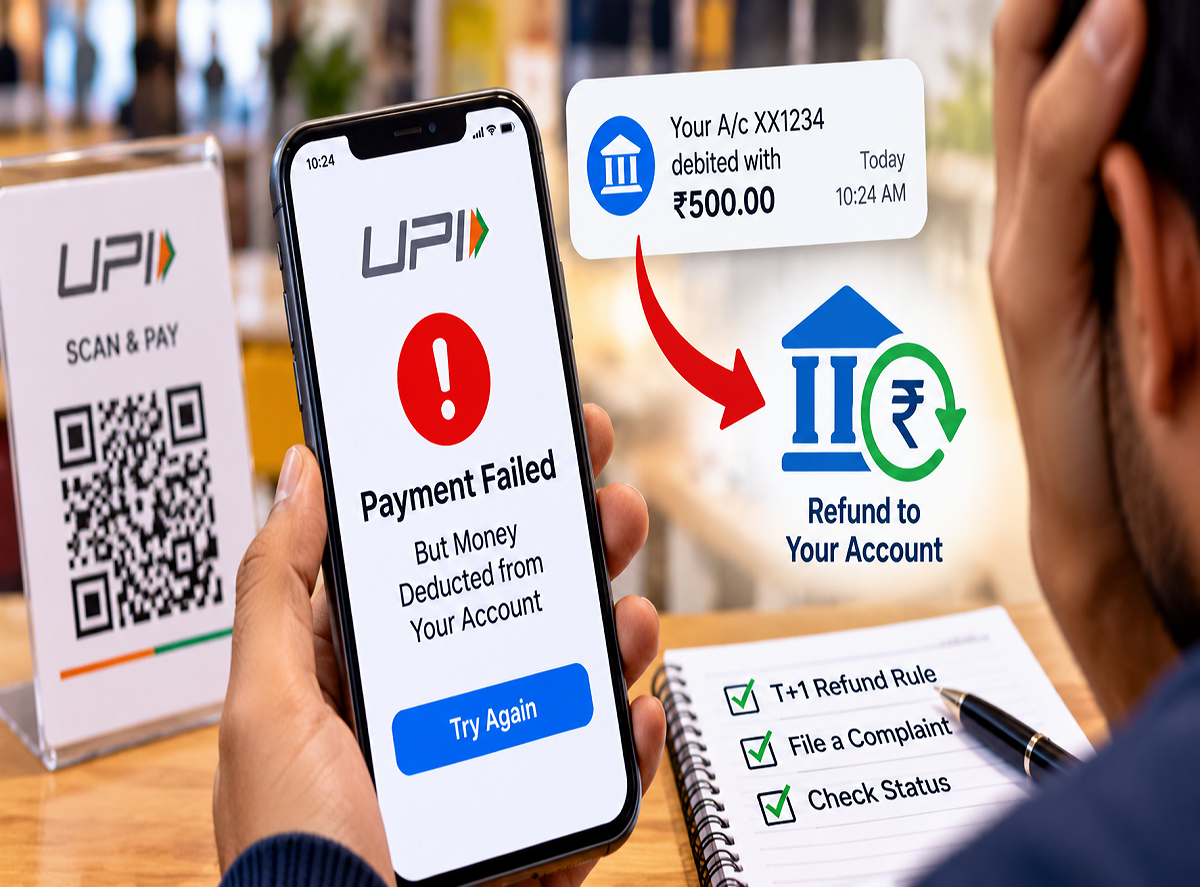
UPI Refund Rules 2026: Digital payments have become part of everyday life in India. From grocery shopping and electricity bills to online purchases and money transfers, millions of people use UPI applications such as PhonePe, Google Pay, Paytm and BHIM.
However, sometimes a UPI transaction fails even after the money has been deducted from the sender's bank account. This situation can be particularly stressful when the amount is large or the payment is urgent.
The good news is that failed UPI transactions are covered by payment-system rules, including prescribed reversal timelines and compensation provisions in eligible cases.
If your money has been deducted but the recipient has not received it, understanding the correct procedure can help you recover the amount and avoid unnecessary confusion.
Why Does a UPI Payment Fail After Money Is Deducted?
UPI transactions usually take only a few seconds. However, technical problems can occasionally interrupt the payment process.
A transaction may fail or remain pending because of:
- Temporary banking server problems.
- Network connectivity issues.
- Delays in communication between participating banks.
- Technical problems with the UPI application.
- Payment processing interruptions.
- Delayed confirmation from the beneficiary bank.
Sometimes the sender's bank debits the amount, but the receiving bank does not successfully credit the beneficiary.
In other situations, a merchant payment may not receive final confirmation even though the customer's account has been debited.
The applicable refund timeline depends on the type of failed transaction.
First, Check Your UPI Transaction Status
Before raising a complaint, check whether the payment is marked as successful, failed or pending.
Follow these steps:
Step 1: Open the UPI application used for the payment.
Step 2: Go to the transaction history or payment activity section.
Step 3: Select the transaction for which money was deducted.
Step 4: Check the current payment status.
Step 5: Note the transaction ID, date, time and amount.
If the transaction shows as pending, wait for the final status before repeating the payment, unless the situation requires immediate action.
Making another payment without checking the first transaction may result in duplicate transfers.
UPI Refund Rules: How Long Does It Take to Get Money Back?
The Reserve Bank of India has prescribed turnaround times for certain failed electronic payment transactions.
The applicable timeline differs depending on whether the transaction is a person-to-person transfer or a merchant payment.
| Failed UPI Transaction Type | Prescribed Reversal Timeline |
|---|---|
| Person-to-person transfer where the beneficiary account is not credited | T+1 day |
| Merchant payment where confirmation is not received at the merchant location | T+5 days |
Here, T means the date of the transaction.
These timelines apply to the relevant failed-transaction categories under RBI's framework. They should not be confused with ordinary refunds requested after a successfully completed purchase.
For example, if a qualifying person-to-person UPI transfer fails on Monday, the applicable reversal deadline is generally Tuesday.
A qualifying failed merchant transaction may have a longer reversal period.
Can You Get ₹100 Compensation for a Delayed UPI Refund?
Yes, RBI's failed-transaction framework provides compensation for certain delays beyond the prescribed turnaround time.
For eligible failed UPI transactions, the compensation is ₹100 per day for delays beyond the applicable deadline.
The framework requires compensation to be paid automatically in qualifying cases.
However, the compensation provision does not apply to every payment dispute.
For example, sending money to the wrong UPI ID, paying a fraudulent recipient or requesting a refund for a cancelled order involves different circumstances.
Customers should first determine whether their case qualifies as a failed transaction under the applicable RBI rules.
How to File a UPI Complaint Through PhonePe, Google Pay or Paytm
Most UPI applications provide a transaction-related complaint facility.
Although menu names vary, the general process is similar.
- Open the UPI application.
- Visit the payment history section.
- Select the affected transaction.
- Tap the Help, Support or Raise an Issue option.
- Choose the relevant payment problem.
- Submit the complaint with the requested information.
- Save the complaint or reference number.
The application may display the transaction's current status and provide further instructions.
If the issue remains unresolved, contact the bank linked to the transaction.
Contact Your Bank if the Refund Is Delayed
If the money is not returned within the applicable period, the account-holding bank should be contacted through an official customer care channel.
The bank can investigate the transaction and coordinate with the relevant payment-system participants.
Keep the following details ready:
| Required Information | Why It Matters |
|---|---|
| Transaction date | Helps identify the payment |
| Transaction time | Supports transaction tracing |
| Amount deducted | Confirms the disputed value |
| UPI transaction ID or reference number | Helps locate the transaction |
| Bank account details | Identifies the affected account |
| Payment status | Shows whether the transaction failed or remained pending |
| Complaint reference number | Helps track the grievance |
Customers should use only official bank websites, applications or verified customer care numbers.
Never share your UPI PIN, banking password or OTP with anyone claiming to process a refund.
How to Escalate a UPI Complaint
If the UPI application or bank does not resolve the issue, customers can follow the available grievance escalation process.
This may include the relevant UPI service provider, payment service provider bank and other designated complaint-handling authorities.
The National Payments Corporation of India (NPCI) also provides information about UPI dispute and complaint mechanisms through its official website.
Customers should retain all complaint acknowledgements and transaction details.
How to File a Complaint With the RBI
If a bank or other RBI-regulated entity does not resolve a complaint satisfactorily, eligible customers can approach the RBI Integrated Ombudsman Scheme.
The official complaint portal is:
Generally, a customer must first complain to the regulated entity.
If the entity rejects the complaint, provides an unsatisfactory response, or fails to respond within 30 days, the customer may be eligible to approach the RBI Ombudsman, subject to the scheme's conditions.
The process involves:
Step 1: Visit the RBI Complaint Management System portal.
Step 2: Select the option to file a complaint.
Step 3: Provide the required personal and transaction details.
Step 4: Enter information about the complaint already submitted to the bank or regulated entity.
Step 5: Upload supporting documents, where required.
Step 6: Submit the complaint and preserve the acknowledgement number.
The RBI Ombudsman process is not a replacement for the initial complaint to the bank.
What if You Sent Money to the Wrong UPI ID?
A payment made to the wrong recipient is different from a transaction that failed because of a technical problem.
If the transfer was completed successfully, an automatic refund is not guaranteed.
Customers should immediately contact their bank and raise a complaint through the UPI application.
Recovery may depend on the circumstances and the applicable dispute-resolution process.
If the transfer involves suspected fraud, the customer should report it promptly through official banking channels.
Financial cyberfraud can also be reported through the 1930 helpline or the National Cyber Crime Reporting Portal at https://cybercrime.gov.in/.
Important Safety Tips for UPI Users
Fraudsters sometimes contact customers after failed payments and promise immediate refunds.
They may ask users to enter a UPI PIN, scan a QR code or install a remote-access application.
Remember that entering a UPI PIN generally authorises a payment, not the receipt of an ordinary refund.
Do not approve unknown collect requests or disclose confidential banking credentials.
Use the transaction history in your official UPI application and verify any refund directly through your bank account.
Final Update
If a UPI payment fails but money is deducted, first check the transaction status and preserve the payment reference number.
Under RBI's prescribed failed-transaction framework, qualifying person-to-person UPI transfers generally require reversal by T+1 day, while certain failed merchant payments have a T+5-day timeline.
Eligible delays beyond these deadlines can attract compensation of ₹100 per day.
If the refund does not arrive within the applicable period, raise a complaint through your UPI application and bank. Unresolved eligible grievances can subsequently be escalated through the RBI Complaint Management System.
Official resources:
- RBI Complaint Portal: https://cms.rbi.org.in/
- NPCI: https://www.npci.org.in/
- Cybercrime Reporting Portal: https://cybercrime.gov.in/