LIFESTYLE
Amrutesvara Temple: The Amruteshwar temple is 800 years old, and a Trimurti Shivalinga is enshrined in its sanctum..

Amrutesvara Temple, Chikmagalur: India has many temples that are not only centers of devotion but also of art, history, and peace. Located in Amritapura, a small village on the banks of the Bhadra River, just 67 km from the Chikmagalur district in Karnataka, stands the Amrutesvara Temple, a priceless gem of Chalukya empire architecture. This temple is a witness to the Ramayana depicted in reverse order, and its other mysteries are equally astonishing.

Epics inscribed on stones
Built during the reign of the Hoysala dynasty, this temple has become an icon of Karnataka's architectural heritage. Constructed in 1196 AD, this Shiva temple not only offers spiritual peace to devotees but also presents tourists with a world of 800-year-old carvings and epics inscribed on stone, leaving them in awe.
Temple built in the Hoysala style.
The Amrutesvara Temple was built by the Hoysala emperor Veera Ballala II and is not only dedicated to Lord Shiva but is also a testament to the art, craftsmanship, and spirituality of that era. Built in the Hoysala style, the temple is as beautiful on the outside as it is on the inside. The outer walls of the temple are covered with circular designs and carvings. In front is a closed mandapa (hall) followed by a large open mandapa. Both are supported by polished lathe-turned pillars. Looking at these gleaming pillars, it's hard to believe that they are more than 800 years old.
140 epic narratives on the walls
The most unique feature of the temple is the 140 epic narratives depicted on its outer walls. On the southern wall, 70 scenes from the Ramayana are carved in a counter-clockwise direction, while the northern wall features 25 panels depicting the childhood exploits of Lord Krishna and the remaining 45 panels beautifully illustrate events from the Mahabharata through intricate carvings. It's as if the entire epic has been inscribed on stone. The sanctum sanctorum houses the Trimurti Shivalinga.
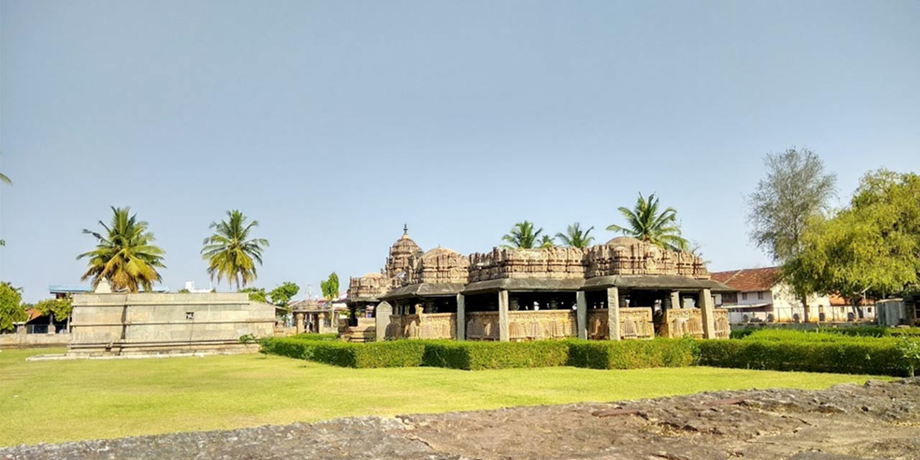
It is believed that Mallitamma, a sculptor of the Hoysala art style, began his artistic journey here, and this temple is considered the first chapter of the Hoysala golden age. The sanctum sanctorum houses an ancient Trimurti Shivalinga brought from the Gandaki River in Nepal, and beside it stands an idol of Goddess Sharada.
The walls are adorned with carvings of a warrior fighting a lion, Kirtimukha on the spire, small towers, and a scene depicting the slaying of Gajāsura. The ceilings feature floral designs, and the pillars are intricately carved.
The tranquil atmosphere, the gentle murmur of the Bhadra River, and the lush greenery stretching as far as the eye can see attract tourists. The Bilva Archana and Kumkum Archana rituals are particularly famous at this temple.
PC Social Media