Business
8th Pay Commission: How Much Could Basic Pay Rise in 5 Years With 3%, 5% or 6% Annual Increments?
8th Pay Commission Increment Calculation: Discussions surrounding the 8th Central Pay Commission are not limited to the fitment factor and revised pay matrix. The annual increment rate could also play a major role in determining how quickly the basic salaries of Central Government employees grow after the new pay structure is introduced.
Under the 7th Pay Commission, employees generally receive an annual increment of around 3% of their basic pay. However, several employee organisations have proposed raising this rate to 5%, 6% or even 7% under the 8th Pay Commission.
A higher annual increment would not only improve the basic salary but could also increase Dearness Allowance, House Rent Allowance, retirement contributions and certain long-term service benefits. Here is an illustrative calculation showing how the starting basic pay of employees in Levels 1, 2 and 3 could grow over five years under annual increment rates of 3%, 5% and 6%.
Why the Annual Increment Rate Matters
An annual increment is added to an employee’s basic pay every year. Since each subsequent increment is calculated on the revised basic salary, employees receive the benefit of compounding.
For example, a 5% increment in the second year would be calculated on the salary reached after the first year’s increment, rather than on the original starting salary.
This means even a small difference in the annual increment rate can create a substantial salary gap over a longer period.
What Have Employee Organisations Demanded?
Several Central Government employee bodies have reportedly recommended an increase in the existing annual increment rate.
The National Council of the Joint Consultative Machinery, the All India Defence Employees Federation and the Federation of National Postal Organisations have sought an increase from 3% to 6%.
The Indian Railway Supervisors Association has reportedly proposed a 5% annual increment, while the All India NPS Employees Federation has supported an even higher rate of 7%.
These are demands from employee organisations and should not be treated as an approved decision. The 8th Pay Commission has not yet announced a final annual increment structure.
Level 1 Basic Pay Calculation
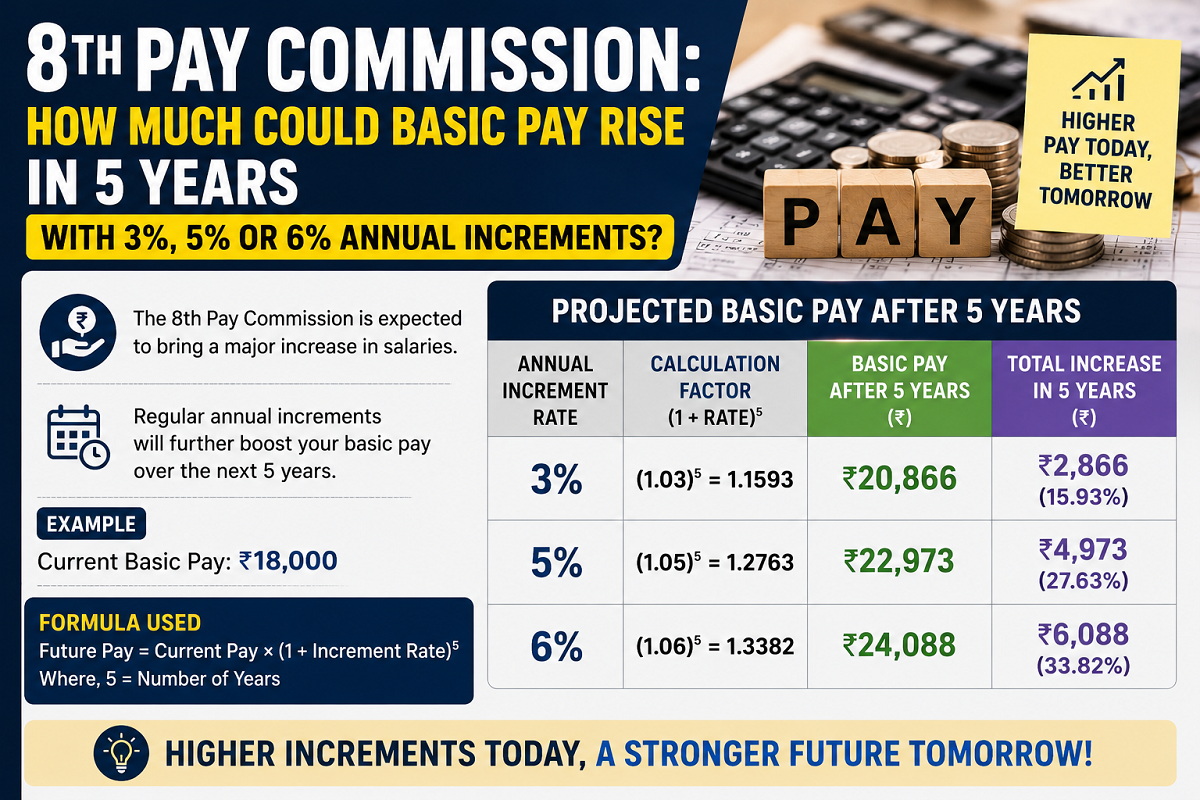
Under the existing 7th Pay Matrix, the starting basic salary for Level 1 is ₹18,000.
| Year | Basic Pay at 3% | Basic Pay at 5% | Basic Pay at 6% |
|---|---|---|---|
| Starting Pay | ₹18,000 | ₹18,000 | ₹18,000 |
| After 1 Year | ₹18,540 | ₹18,900 | ₹19,080 |
| After 2 Years | ₹19,096 | ₹19,845 | ₹20,225 |
| After 3 Years | ₹19,669 | ₹20,837 | ₹21,438 |
| After 4 Years | ₹20,259 | ₹21,879 | ₹22,725 |
| After 5 Years | ₹20,867 | ₹22,973 | ₹24,088 |
After five years, a Level 1 employee’s basic pay could rise by approximately:
- ₹2,867 with a 3% annual increment
- ₹4,973 with a 5% annual increment
- ₹6,088 with a 6% annual increment
The difference between the 3% and 6% scenarios would be more than ₹3,200 per month in basic pay after five years.
Level 2 Basic Pay Calculation
The starting basic salary for Level 2 employees is ₹19,900.
| Year | Basic Pay at 3% | Basic Pay at 5% | Basic Pay at 6% |
|---|---|---|---|
| Starting Pay | ₹19,900 | ₹19,900 | ₹19,900 |
| After 1 Year | ₹20,497 | ₹20,895 | ₹21,094 |
| After 2 Years | ₹21,112 | ₹21,940 | ₹22,360 |
| After 3 Years | ₹21,745 | ₹23,037 | ₹23,701 |
| After 4 Years | ₹22,398 | ₹24,189 | ₹25,123 |
| After 5 Years | ₹23,070 | ₹25,398 | ₹26,631 |
Over five years, the estimated increase would be:
- ₹3,170 at 3%
- ₹5,498 at 5%
- ₹6,731 at 6%
A 6% annual increment could therefore take the Level 2 basic salary above ₹26,600 after five years, based on simple compounding.
Level 3 Basic Pay Calculation
Level 3 currently begins with a basic salary of ₹21,700.
| Year | Basic Pay at 3% | Basic Pay at 5% | Basic Pay at 6% |
|---|---|---|---|
| Starting Pay | ₹21,700 | ₹21,700 | ₹21,700 |
| After 1 Year | ₹22,351 | ₹22,785 | ₹23,002 |
| After 2 Years | ₹23,022 | ₹23,924 | ₹24,382 |
| After 3 Years | ₹23,712 | ₹25,120 | ₹25,845 |
| After 4 Years | ₹24,424 | ₹26,376 | ₹27,396 |
| After 5 Years | ₹25,156 | ₹27,695 | ₹29,040 |
The total estimated rise in five years would be:
- ₹3,456 with a 3% increment
- ₹5,995 with a 5% increment
- ₹7,340 with a 6% increment
The gap between the 3% and 6% outcomes would be nearly ₹3,884 per month in basic pay after five years.
How a Higher Basic Salary Could Affect Allowances
A larger basic salary can influence several other components of an employee’s compensation.
Dearness Allowance and HRA
Dearness Allowance and House Rent Allowance are generally linked to basic pay. Therefore, when the basic salary rises, the monetary value of these allowances may also increase.
NPS and Provident Fund Contributions
Retirement contributions are linked to salary components such as basic pay and DA. A higher basic salary could result in larger employee and government contributions, helping employees build a stronger retirement corpus.
Gratuity and Retirement Benefits
Certain retirement benefits are calculated with reference to the employee’s last drawn salary or basic pay. Faster salary growth may therefore have a long-term impact on gratuity, pension-related calculations and other retirement benefits, subject to applicable rules.
These Figures Are Only Illustrative
The calculations above use the existing starting salaries under the 7th Pay Matrix and apply annual compounding at 3%, 5% and 6%. They do not include pay-matrix rounding rules, promotions, MACP benefits, revised fitment factors, changes in allowances or any future government-approved salary structure.
The 8th Pay Commission has not yet approved an annual increment rate. Therefore, these figures should be viewed only as estimates showing how different increment percentages could affect basic pay over five years.