Business
Revised ITR Filing 2026: Made a Mistake After Submitting Your Tax Return? Here's How to Correct It Before the Deadline
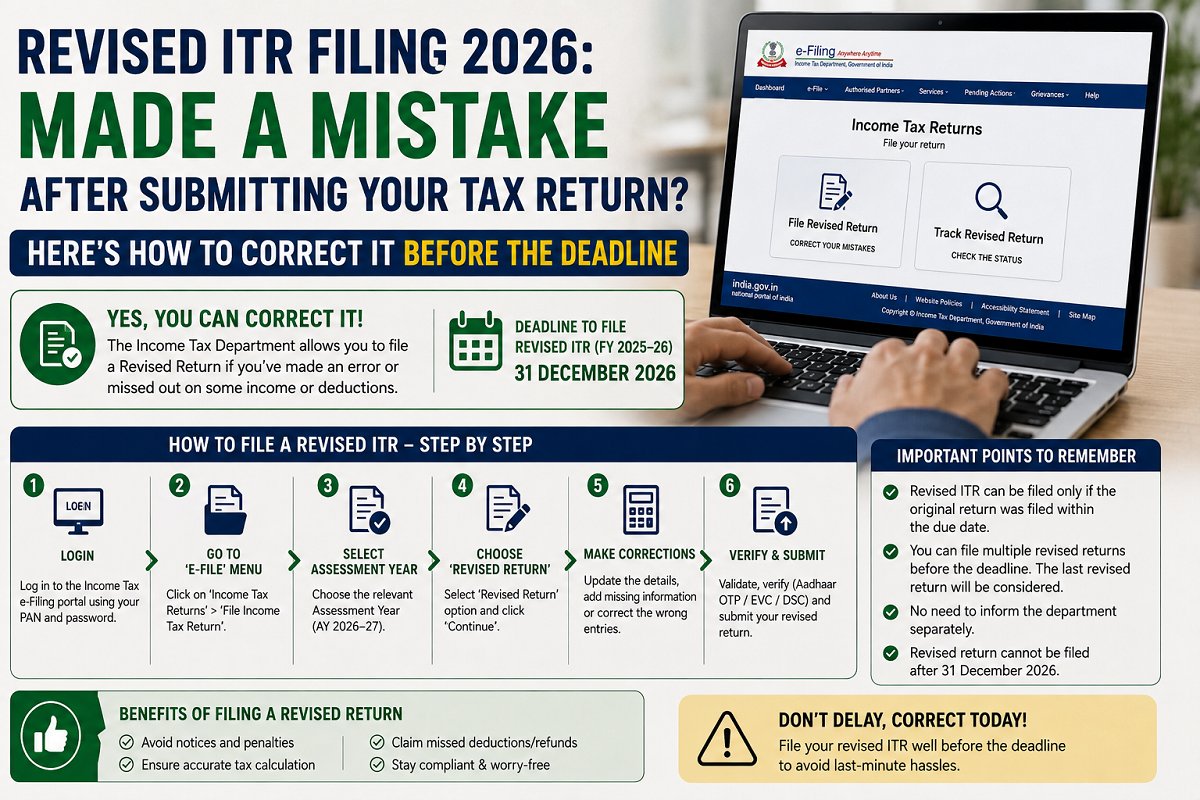
Revised ITR 2026: Taxpayers who have already filed their Income Tax Return (ITR) for FY 2025-26 but later discovered an error do not need to panic. The Income Tax Act allows eligible taxpayers to submit a revised return and correct mistakes such as omitted income, incorrect deductions, or inaccurate personal details before the prescribed deadline.
If you filed your return before July 31, 2026 and later noticed that some information was entered incorrectly or an important financial detail was left out, here's everything you need to know about filing a revised return.
What Is a Revised ITR?
A revised Income Tax Return is a corrected version of an ITR that has already been filed. Under Section 139(5) of the Income Tax Act, taxpayers can update their original return if they later discover any mistake, omission, or incorrect information.
This provision helps taxpayers voluntarily correct genuine filing errors without submitting a completely new return.
Who Can Submit a Revised Return?
A revised return can generally be filed by taxpayers who have:
- Filed their original return within the prescribed due date under Section 139(1).
- Submitted a belated return under Section 139(4), if eligible under the applicable rules.
- Identified errors such as missing income, incorrect deductions, wrong bank details, or inaccurate financial information after filing.
The law also permits taxpayers to revise their return multiple times, provided it is done within the permitted time limit.
Last Date to File a Revised ITR
For Financial Year 2025-26 (Assessment Year 2026-27), a revised return can be filed up to December 31, 2026, or before the Income Tax Department completes the assessment of that return—whichever occurs earlier.
Once the assessment process is completed, further revision may no longer be permitted.
Important Points to Remember Before Revising Your Return
Before filing a revised ITR, taxpayers should carefully verify the following:
1. Keep the Original ITR Acknowledgement Ready
While filing the revised return, you must provide:
- Original ITR acknowledgement number
- Original filing date
These details help the department link the revised return with the earlier submission.
2. Select the Correct ITR Form
Use the same ITR form that was used while filing the original return unless your income profile has changed and another form has become applicable.
3. Cross-Check AIS and Form 26AS
Before making corrections, compare your return with:
- Annual Information Statement (AIS)
- Form 26AS
This helps ensure that no interest income, dividend, capital gains, TDS details, or other financial transactions are left out again.
4. Complete e-Verification
Submitting the revised return alone is not enough.
Just like the original return, the revised ITR must also be e-verified within 30 days. If verification is not completed, the revised return may be treated as invalid.
Step-by-Step Process to File a Revised ITR Online
Taxpayers can submit a revised return through the Income Tax Department's e-filing portal by following these steps:
Step 1: Log in to the Income Tax e-filing portal using your PAN or Aadhaar credentials.
Step 2: Go to e-File → Income Tax Returns → File Income Tax Return.
Step 3: Select Assessment Year 2026-27 and choose "Revised Return under Section 139(5)" as the filing type.
Step 4: Enter the acknowledgement number and filing date of your original return.
Step 5: Correct the required information, such as:
- Additional income
- Missed deductions
- Incorrect bank details
- Capital gains
- Interest income
- Personal information
Step 6: Recalculate your tax liability. If any additional tax becomes payable, make the payment before submitting the revised return.
Step 7: Submit the revised return and complete e-verification using Aadhaar OTP, net banking, or any other approved verification method.
Common Errors That Can Be Corrected
A revised return can be used to rectify several common filing mistakes, including:
- Omission of bank interest income
- Unreported capital gains
- Missing dividend income
- Incorrect deduction claims
- Wrong bank account details
- Errors in personal information
- Calculation mistakes in taxable income
Why Filing a Revised Return Is Important
Correcting mistakes before they are identified by the tax department can help taxpayers maintain accurate records and reduce the chances of future compliance issues. Reviewing all financial statements, AIS, Form 26AS, and supporting documents before filing the revised return can make the correction process smoother.
Taxpayers should ensure that all information is accurate before the final submission and complete e-verification within the prescribed timeline to make the revised return valid.
Disclaimer: This article is intended for general informational purposes only. Tax laws and filing requirements may change over time. Taxpayers should refer to official Income Tax Department notifications or consult a qualified tax professional before making tax-related decisions.