Business
Silver Price Outlook: Silver Drops ₹65,000 This Year—Should You Buy Now or Wait? Experts Share Their View
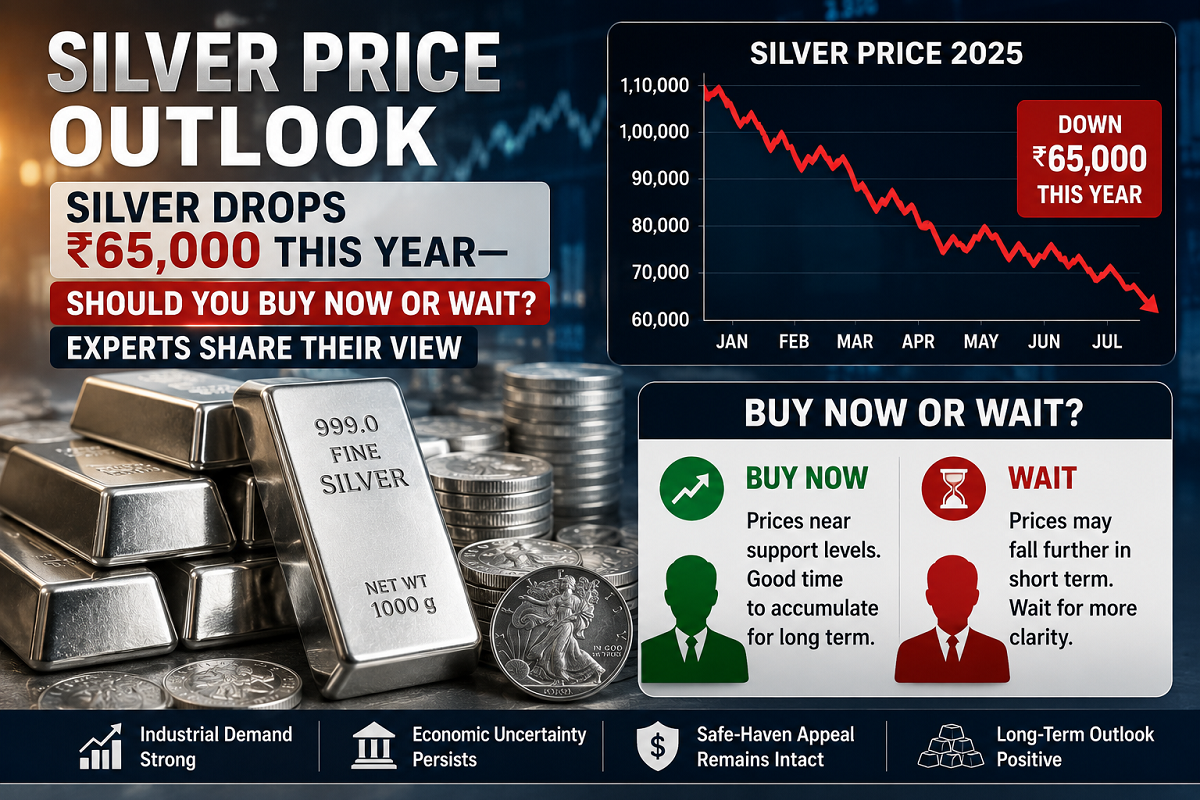
Silver Price Outlook: Silver has witnessed a sharp correction in 2026, with prices falling by nearly ₹65,000 per kilogram from this year's highs. After delivering exceptional gains over the past year, the precious metal has now entered a period of volatility, leaving investors wondering whether the decline is over or if further downside remains.
Market analysts believe that the next move in silver will largely depend on global inflation trends, crude oil prices, the US Federal Reserve's interest rate decisions, and industrial demand. Here's a detailed look at why silver has weakened and what experts expect in the coming months.
Silver Has Corrected Sharply in 2026
Silver has underperformed for much of the year, declining by nearly 23% since the beginning of 2026. June alone witnessed a steep correction of around 22%, making it one of the weakest months for the metal in recent years.
Despite the recent decline, silver continues to trade at approximately $58 per ounce in international markets, while domestic prices remain close to ₹2.20 lakh per kilogram.
Interestingly, this correction follows an exceptionally strong rally during the previous year, when silver generated returns of more than 50%. The latest decline has brought prices back to levels seen around December 2025, prompting investors to reassess the market outlook.
Rising Crude Oil Prices Have Added Pressure
According to market experts, one of the biggest reasons behind silver's weakness has been the sharp rise in crude oil prices.
Geopolitical tensions in the Middle East, particularly after the Iran conflict and uncertainty surrounding the Strait of Hormuz, have disrupted supply expectations and pushed energy prices higher.
Brent crude has been trading near $86 per barrel, roughly 20% above levels seen before the conflict intensified.
Higher oil prices generally increase inflationary pressure across global economies, creating uncertainty in financial markets and influencing investor sentiment toward precious metals.
Why the US Federal Reserve Matters
Inflation and interest rates remain among the most important drivers for gold and silver prices.
When inflation rises due to expensive energy, the US Federal Reserve may maintain higher interest rates or delay monetary easing. Elevated interest rates usually strengthen the US dollar and increase the appeal of interest-bearing assets.
Since gold and silver do not generate regular income like bonds or fixed-income investments, investors often reduce exposure to precious metals when interest rates remain high.
As a result, silver prices can come under additional pressure whenever expectations of higher US rates strengthen.
Silver Is More Volatile Than Gold
Unlike gold, silver serves a dual purpose—it is both a precious metal and an industrial raw material.
Its demand comes from several fast-growing industries, including:
- Solar panel manufacturing.
- Consumer electronics.
- Electric vehicles (EVs).
- Data centres.
- Power transmission infrastructure.
Because of its industrial applications, even small changes in manufacturing activity or economic growth can significantly influence silver prices. This makes silver considerably more volatile than gold during periods of economic uncertainty.
Understanding the Gold-Silver Ratio
Investors often monitor the Gold-Silver Ratio to evaluate the relative value of the two metals.
The ratio indicates how many ounces of silver are required to purchase one ounce of gold.
Historically:
- A ratio above 75 is generally viewed as an indication that silver is relatively undervalued compared to gold.
- A ratio between 50 and 60 suggests gold may be comparatively cheaper.
During June 2026, when gold traded around $4,000–4,060 per ounce, silver remained near $60–61 per ounce, resulting in a ratio close to 67.
Earlier in the year, the ratio had fallen to around 50–55, reflecting stronger silver performance.
Is Silver Attractive at Current Levels?
Market analysts believe the current Gold-Silver Ratio remains close to its long-term average.
According to experts, silver still appears moderately undervalued compared with gold, particularly if industrial demand continues to recover over the coming quarters.
Domestic silver prices have remained above ₹2 lakh per kilogram since December 2025, indicating that long-term demand remains relatively resilient despite recent corrections.
What Could Drive Silver Higher?
Analysts expect the Gold-Silver Ratio to remain between 65 and 75 in the near term.
Silver could outperform gold if:
- The US Federal Reserve begins reducing interest rates.
- The US dollar weakens.
- Global manufacturing activity improves.
- Industrial demand accelerates.
Under such circumstances, the Gold-Silver Ratio could decline toward 60–65, signalling stronger silver performance.
On the other hand, if geopolitical tensions intensify, recession fears increase, or investors shift toward traditional safe-haven assets, gold may continue outperforming silver and the ratio could remain above 70.
What Should Investors Do?
Experts generally recommend avoiding an all-or-nothing approach.
Instead of investing exclusively in either gold or silver, maintaining a balanced allocation across both metals may provide better diversification.
Investors seeking capital preservation and relatively lower volatility may prefer gold. However, those with a longer investment horizon and a higher risk appetite may consider gradually increasing exposure to silver, especially if they believe industrial demand will strengthen in the coming years.
Disclaimer: Market opinions quoted in this article reflect analysts' views and should not be treated as investment advice. Precious metal prices are influenced by global market conditions and may fluctuate significantly. Investors should consult a qualified financial advisor before making investment decisions.