Business
8th Pay Commission: What Is Pay Scale Merger and Why Are Central Government Employees Demanding It?
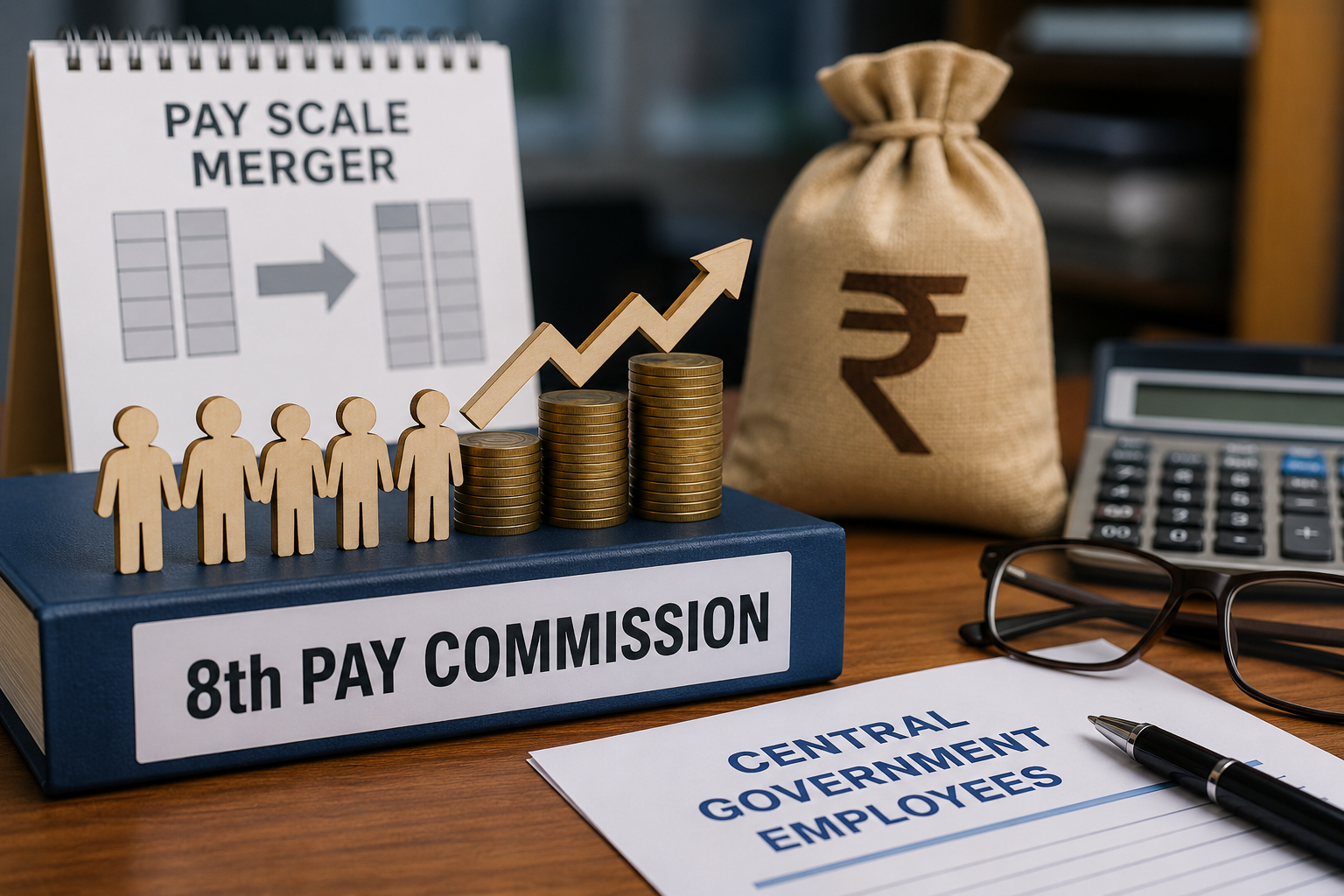
8th Pay Commission Update: As the 8th Central Pay Commission moves into its consultation phase, employee unions have submitted several key proposals aimed at restructuring the existing pay matrix. One of the most significant demands is the merger of multiple pay levels, which unions believe will reduce pay disparities, simplify promotions, and address long-standing career stagnation. Here's a detailed look at what pay scale merger means, why employees are seeking it, and the other major demands placed before the commission.
8th Pay Commission Enters a Crucial Stage
The 8th Pay Commission has entered one of its most important phases after receiving suggestions from Central Government employees, pensioners, ministries, and employee organizations.
The commission is expected to recommend revisions to the salary structure, pensions, and allowances for nearly 50 lakh Central Government employees and around 65 lakh pensioners.
Among the various proposals submitted by employee unions, the restructuring of the existing pay matrix through the merger of several pay levels has emerged as one of the most widely discussed demands.
What Is a Pay Scale Merger?
A pay scale merger refers to combining two or more existing pay levels into a single unified pay level.
According to employee unions, several adjacent pay levels currently include employees performing similar duties and responsibilities while receiving salaries that differ only marginally. They argue that maintaining separate pay levels for these positions creates unnecessary disparities and dissatisfaction among employees.
To address this issue, unions have proposed merging the following pay levels:
- Pay Level 2 and Level 3
- Pay Level 4 and Level 5
- Pay Level 7 and Level 8
- Pay Level 9 and Level 10
The proposal aims to simplify the pay structure and improve career progression across departments.
Why Are Employee Unions Seeking This Change?
Employee organizations argue that the present pay matrix often places employees with comparable responsibilities in different pay levels, resulting in limited financial differences but separate promotional hierarchies.
According to the unions, merging pay levels could:
- Reduce salary disparities among employees performing similar work.
- Simplify the overall pay structure.
- Improve promotional opportunities.
- Minimize career stagnation.
- Increase employee satisfaction.
Another key proposal is the direct upgrade of employees in Pay Level 5 to Pay Level 6, particularly for Group C employees working in departments such as:
- Central Secretariat
- Defence
- Indian Railways
- Department of Posts
Unions believe this change would help address slow career progression in these services.
Other Major Demands Submitted to the 8th Pay Commission
Apart from pay scale restructuring, employee representatives have placed several other important demands before the commission.
Minimum Basic Salary of ₹69,000
The National Council–Joint Consultative Machinery (NC-JCM) has proposed increasing the minimum basic pay to ₹69,000 per month, substantially higher than the current level.
Annual Increment of 6%
Employee unions have recommended raising the annual salary increment from the existing 3% to 6%, arguing that it would better reflect inflation and rising living costs.
Stronger Link Between Salary and Inflation
Another major demand is to ensure that salary revisions are more closely aligned with inflation so that employees' purchasing power remains protected over time.
Easier Promotion Policy
Unions have also called for a more transparent and simplified promotion system to reduce delays and career stagnation across government departments.
Commission's Structure and Consultation Process
The 8th Central Pay Commission was constituted on November 3, 2025.
The commission is chaired by former Supreme Court Justice Ranjana Prakash Desai.
Other key members include:
- Pankaj Jain, former IAS officer and Member Secretary
- Professor Pulak Ghosh, Member of the Prime Minister's Economic Advisory Council
The commission completed the first phase of collecting suggestions from employees and the general public on June 15, while ministries were asked to submit relevant data by July 31.
Since March, commission members have been meeting employee unions, pensioners' associations, and representatives from departments including Railways, Defence, and other Central Government organizations as part of the consultation process.
Additional Reforms Sought by Employee Organizations
Employee unions have also recommended improvements beyond salary revisions.
Their proposals include:
- Simplifying Provident Fund (PF) withdrawal procedures
- Faster settlement of medical reimbursement claims
- Improved life insurance coverage for employees and pensioners
- Simplifying income tax documentation and compliance processes
These recommendations aim to improve overall employee welfare alongside financial benefits.
When Could the 8th Pay Commission Recommendations Be Implemented?
The commission has been given approximately 18 months to submit its report.
If the process follows the current schedule, the recommendations are expected to be finalized between February and April 2027.
However, based on the implementation timeline of previous pay commissions, experts believe that the government may require an additional two to three years to fully implement the recommendations.
As a result, although the report may be submitted in 2027, revised salaries, pensions, and allowances could be implemented around 2029 or 2030, depending on government approval and administrative processes.
Final Thoughts
The proposal to merge multiple pay levels has become one of the most significant issues before the 8th Pay Commission. Employee unions believe that combining existing pay scales, increasing the minimum basic salary to ₹69,000, raising annual increments, and simplifying promotion policies would create a fairer and more efficient compensation system for Central Government employees.
At present, these remain proposals submitted by employee organizations, and no final decision has been announced by the 8th Pay Commission or the Central Government. The commission's recommendations will be finalized only after completing consultations and reviewing all stakeholder submissions.