Business
ITR Filing Deadline 2026: Who Must File ITR-3 or ITR-4 by August 31? Check Rules and Late-Filing Costs
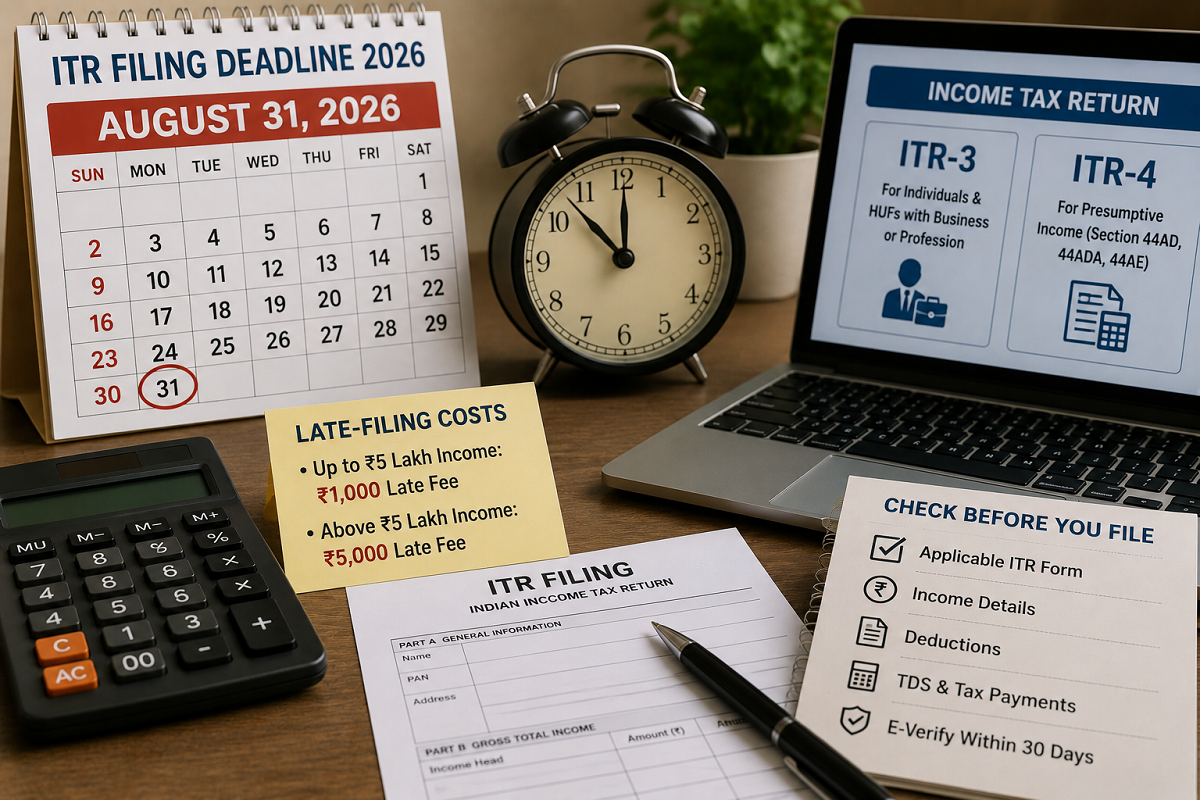
Income Tax Return Deadline: The income tax filing deadline is not identical for every taxpayer. While the earlier due date applied to many salaried individuals and taxpayers without business income, certain non-audit taxpayers earning income from a business or profession have until August 31, 2026, to submit their returns for Assessment Year 2026–27. Those covered by this deadline should file on time to avoid late fees, interest, and possible restrictions on carrying forward eligible losses.
Who Is Covered by the August 31 ITR Deadline?
The August 31, 2026 deadline primarily applies to eligible taxpayers who earned income from a business or profession during Financial Year 2025–26 but are not required to get their accounts audited.
The Income Tax Department’s guidance confirms that the due date for eligible ITR-4 filers for Assessment Year 2026–27 is August 31, 2026. The notified ITR-3 form also recognises August 31 as one of the applicable return-filing due dates. (Income Tax Department)
The main categories may include the following:
Proprietors and Professionals Filing ITR-3
Individuals carrying on a business or profession may need to file ITR-3, particularly where their income does not qualify for the simplified presumptive taxation return.
The August 31 deadline may apply where such taxpayers are not required to undergo a tax audit.
Taxpayers Using the Presumptive Taxation Scheme
Eligible resident individuals, Hindu Undivided Families and certain firms, excluding LLPs, may use ITR-4, also known as Sugam, when they declare eligible business or professional income under the presumptive taxation provisions and satisfy the prescribed conditions.
For Assessment Year 2026–27, the official due date for eligible ITR-4 filers is August 31, 2026. (Income Tax Department)
Which ITR Form Should You Choose?
Selecting the correct income tax return form is essential because filing an unsuitable form may result in the return being treated as defective.
ITR-3
ITR-3 generally applies to individuals and Hindu Undivided Families earning income from a proprietary business or profession who are not eligible to use ITR-4.
It may cover income from:
- A business or profession
- Salary or pension
- House property
- Capital gains
- Other sources
- Partnership firm remuneration or interest
ITR-4
ITR-4 is a simplified return available to eligible taxpayers opting for presumptive taxation, subject to the applicable income, residential-status and eligibility conditions.
The form is commonly used by eligible small businesses, professionals and specified transport operators declaring income under the presumptive taxation system.
Taxpayers should carefully check the official eligibility requirements because having business income does not automatically mean that ITR-4 can be used.
Different Taxpayers Can Have Different Deadlines
Income tax return due dates depend on the taxpayer’s category, source of income, audit requirement and other applicable provisions.
The broad timeline discussed for Assessment Year 2026–27 includes:
- July 31, 2026: Applicable to specified individual taxpayers under the notified return-filing calendar.
- August 31, 2026: Applicable to eligible non-audit business and professional taxpayers, including qualifying ITR-3 and ITR-4 filers.
- October 31, 2026: Applicable to taxpayers whose accounts are required to be audited, subject to the relevant tax rules.
Taxpayers should not assume that the deadline applicable to a salaried employee also applies to a proprietor, consultant or professional.
When Does a Tax Audit Become Mandatory?
Tax audit requirements are governed by the applicable provisions of Section 44AB and related rules.
For a person carrying on business, the standard audit threshold is generally ₹1 crore in annual turnover or gross receipts. This threshold may increase to ₹10 crore where cash receipts and cash payments remain within the prescribed 5% limits. (Etds)
For specified professionals, tax audit requirements may arise when gross professional receipts cross the applicable statutory limit. Because audit rules can also depend on whether presumptive taxation has been chosen or departed from, taxpayers should verify their individual position with a chartered accountant.
What Happens If You Miss the Due Date?
Missing the applicable filing deadline can create several financial and procedural consequences.
Late-Filing Fee
A return submitted after the due date is generally treated as a belated return. A late fee may apply under the relevant provisions, depending on the taxpayer’s income and filing circumstances.
The late fee can be up to ₹5,000, while a lower amount may apply to taxpayers whose total income does not cross the specified threshold.
Interest on Outstanding Tax
Where tax remains unpaid, interest may become payable under the applicable provisions, including Section 234A.
The longer the delay continues, the larger the interest liability may become.
Restrictions on Carrying Forward Losses
Certain business and capital losses may not be allowed to be carried forward if the return is filed after the original due date.
The Income Tax Department also notes that delayed filing can affect claims involving losses and refunds, subject to the relevant law and any available condonation process. (Income Tax Department)
However, some losses, such as eligible house-property loss, may be governed by different rules. Taxpayers should obtain professional advice before assuming that every type of loss will be treated identically.
Delay in Refund Processing
Filing late may also delay the processing of a tax refund. Errors or mismatches could further extend the waiting period.
Documents to Check Before Filing ITR-3 or ITR-4
Before submitting the return, taxpayers should collect and reconcile their financial information.
Important records may include:
- Annual Information Statement
- Taxpayer Information Summary
- Form 26AS
- Bank account statements
- Business income and expense records
- Presumptive income calculations
- TDS and TCS certificates
- Advance tax and self-assessment tax challans
- Capital-gains statements, where applicable
- Details of interest, rent and other income
Income appearing in AIS and Form 26AS should be compared with the figures entered in the return. Any unexplained mismatch may lead to a tax notice or delayed processing.
Do Not Forget to Verify the Return
Filing the return is not the final step. Taxpayers must also complete the verification process.
The Income Tax Department states that the time limit for e-verification or submission of the signed ITR-V is generally 30 days from the date of filing. (Income Tax Department)
The return can normally be verified using options such as:
- Aadhaar OTP
- Net banking
- Bank-account EVC
- Demat-account EVC
- Physical ITR-V, where permitted
An unverified return may not be treated as validly filed.
Taxpayers Should Avoid Waiting Until the Last Day
Eligible ITR-3 and ITR-4 taxpayers should not delay filing until August 31. Last-minute filing can become difficult if the e-filing portal is busy, tax records contain mismatches or additional payments are required.
Filing early provides time to:
- Identify AIS or Form 26AS discrepancies
- Pay any outstanding tax
- Correct bank and personal details
- Select the correct tax regime
- Review deductions and business-income calculations
- Complete e-verification without delay
Final Takeaway
The August 31, 2026 ITR deadline is important for eligible taxpayers earning non-audit business or professional income, including qualifying users of ITR-3 and ITR-4.
Missing the deadline may result in late fees, interest, delayed refunds and loss of the right to carry forward certain eligible losses. Taxpayers should choose the correct form, reconcile their income with AIS and Form 26AS, pay any outstanding tax and verify the return within the prescribed period.
Disclaimer: This article is intended for general information only. Income tax deadlines, form eligibility and audit requirements may vary according to the taxpayer’s circumstances. Consult a chartered accountant or qualified tax professional before filing.