Business
RBI Monetary Policy: What the Unchanged Repo Rate Means for Home Loan EMIs, FD Returns and Borrowers
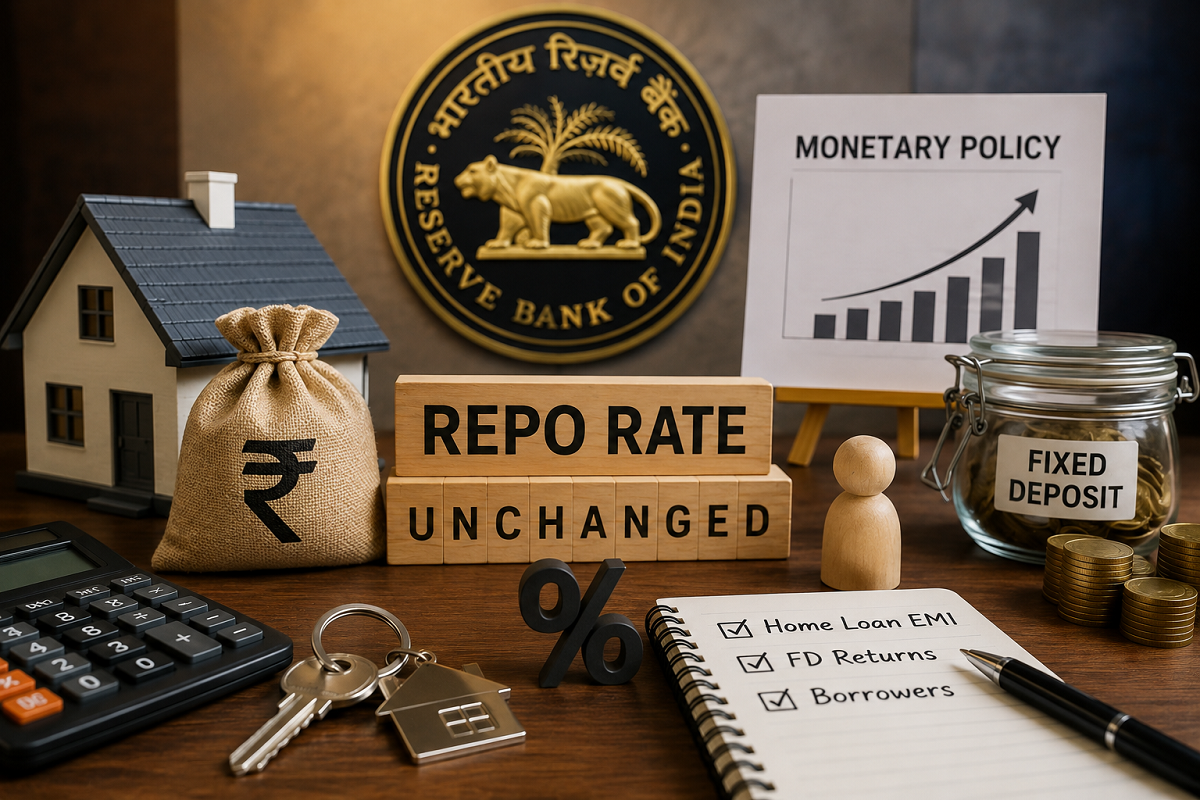
RBI Monetary Policy Update: The Reserve Bank of India (RBI) has decided to keep the repo rate unchanged at 5.25% in its latest Monetary Policy Committee (MPC) meeting. Maintaining its neutral policy stance, the central bank cited global uncertainties, volatile crude oil prices, and India's resilient economic fundamentals as key reasons for holding rates steady. Here's how the decision could affect your home loan EMI, fixed deposit returns, borrowing costs, and the overall economy.
RBI Keeps Repo Rate Unchanged at 5.25%
The Reserve Bank of India has opted to maintain the repo rate at 5.25%, signaling a cautious approach amid evolving domestic and global economic conditions.
The repo rate is the interest rate at which commercial banks borrow funds from the RBI. Any change in this benchmark rate generally influences lending rates, deposit rates, and borrowing costs across the banking system.
Since the repo rate has remained unchanged, banks are unlikely to make immediate revisions to their lending or deposit rates.
1. Home Loan EMIs Are Expected to Remain Stable
One of the biggest takeaways for borrowers is that floating-rate loan EMIs are likely to remain unchanged for now.
Since banks' borrowing costs have not increased, most lenders are not expected to raise interest rates on:
- Home loans
- Car loans
- Personal loans
- Other floating-rate credit products
For existing borrowers, this means monthly EMIs are unlikely to increase immediately. Likewise, people planning to purchase a home or vehicle during the festive season may continue to benefit from the current lending rates.
However, borrowers should note that individual banks may still adjust lending rates based on their own funding costs and business strategies.
2. Fixed Deposit Investors Continue to Benefit
The RBI's decision also provides some stability for depositors.
With the repo rate unchanged, banks are generally not expected to reduce fixed deposit (FD) interest rates immediately.
Investors looking for stable returns may continue to find attractive FD options, with many banks currently offering interest rates in the range of approximately:
- 6.8% to 7.5%, depending on the bank, tenure, and customer category.
Some market experts also suggest that FD laddering—splitting investments across different maturities—may help investors manage interest rate fluctuations more effectively.
3. RBI Raises India's GDP Growth Forecast
Reflecting confidence in the domestic economy, the RBI has revised its GDP growth projection for FY 2026–27.
The central bank has:
- Increased the GDP growth estimate from 6.6% to 6.7%.
According to the RBI, several factors continue to support economic growth, including:
- Strong domestic demand
- Healthy private consumption
- Steady manufacturing activity
- Continued expansion in the services sector
The revised forecast suggests that India's economic fundamentals remain resilient despite global uncertainties.
4. Inflation Forecast Remains Unchanged
The RBI has retained its retail inflation projection at 5.0%.
While inflation remains under close watch, the central bank noted that risks continue to arise from factors such as:
- Geopolitical tensions
- Fluctuations in global commodity prices
- Changes in international energy markets
At the same time, the RBI indicated that core inflation remains relatively contained, supporting its decision to maintain the current policy rate.
5. RBI Retains a Neutral Policy Stance
Along with leaving the repo rate unchanged, the Monetary Policy Committee has continued with its neutral stance.
A neutral stance means future policy decisions will depend on incoming economic data rather than following a predetermined direction.
This provides flexibility for the RBI to:
- Reduce rates if inflation eases further and economic conditions permit.
- Raise rates if inflationary pressures increase unexpectedly.
- Maintain rates if current conditions remain broadly stable.
As a result, the possibility of future repo rate cuts remains open, but any decision will depend on inflation trends, growth data, and developments in the global economy.
What This Means for Consumers
The latest monetary policy decision has different implications for various groups:
For Home Loan Borrowers
- Floating-rate EMIs are expected to remain stable.
- No immediate increase in borrowing costs.
For Fixed Deposit Investors
- Existing FD interest rates are likely to remain attractive in the near term.
- Banks are unlikely to cut deposit rates immediately.
For Prospective Borrowers
- Current loan rates may continue, making this a relatively stable period for financing homes or vehicles.
For the Economy
- The higher GDP growth forecast reflects confidence in India's economic momentum despite global challenges.
Final Thoughts
By keeping the repo rate unchanged at 5.25%, the RBI has chosen stability over immediate policy changes. The decision means home loan EMIs are expected to remain unchanged for most floating-rate borrowers, while fixed deposit investors can continue to benefit from current interest rates. At the same time, the central bank's improved GDP growth outlook and neutral policy stance indicate confidence in India's economic resilience while preserving flexibility for future action.
Although the policy provides short-term certainty for borrowers and savers, future interest rate decisions will continue to depend on inflation, economic growth, and global financial conditions.